
What Is Included in Die Casting Mold Cost?
A die casting tooling quotation normally includes more than the physical steel used to build the mold.
Depending on the project, tooling cost may include:
• Product engineering review
• DFM analysis
• Mold flow simulation
• Mold design
• Mold steel
• Cavity and core machining
• Inserts
• Slides and lifters
• Runner and gating system
• Cooling channels
• Ejection system
• Venting and overflow system
• EDM and wire EDM
• Mold assembly
• Surface treatment
• Mold trial
• Sample production
• Mold modifications
• Inspection and documentation
Comparing two mold quotations only by the final price can be misleading. A lower initial quotation may exclude important tooling features or services that later become additional costs.
Internal link: Die Casting Guide
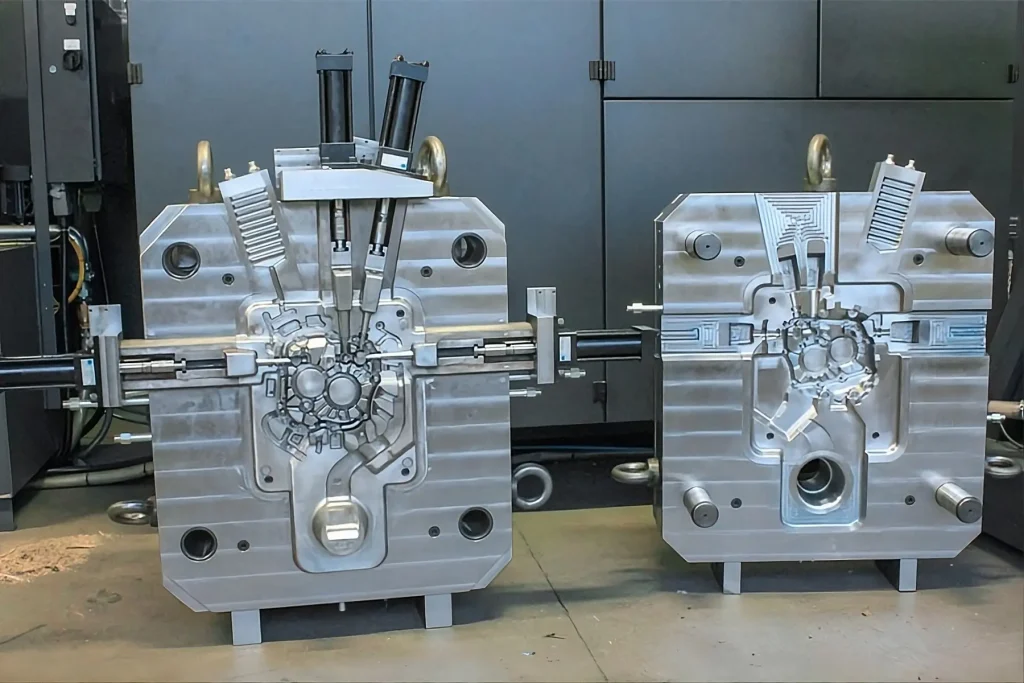
1.Part Size and Mold Size
One of the most direct factors affecting die casting mold cost is the physical size of the part.
A larger part generally requires larger mold plates, more mold steel, larger machining capacity, more complex cooling channels, larger machine capacity, and more demanding mold handling and assembly.
The relationship is not simply proportional to part dimensions. A relatively large part with simple geometry may require less tooling engineering than a smaller component with multiple undercuts, moving cores, or tight sealing requirements.
Example:Part A: simple housing, limited undercuts, standard ejection, simple cooling.
Part B: similar overall size, multiple internal passages, several side cores, tight sealing surfaces, complex cooling requirements.
Part B can require considerably more expensive tooling even if the external dimensions are similar.
2.Part Complexity and Mold Structure
Part geometry is one of the most important factors in die casting mold price.
A simple part may use a straightforward two-half mold structure. More complicated components may require sliders, lifters, multiple core inserts, movable cores, replaceable inserts, complex ejection systems, special venting, multiple overflow locations, and advanced cooling.
Features that commonly increase tooling cost include deep cavities, internal undercuts, side holes, thin walls, tight tolerances, complex ribs, sealing surfaces, long flow paths, and multiple functional surfaces.
Reducing unnecessary geometric complexity can be one of the most effective ways to control tooling investment.
3. Number of Cavities
A single-cavity mold produces one casting per cycle and may suit limited production volume, large parts, highly complex geometry, lower initial tooling investment, or projects where flexibility is more important than maximum output.
A multi-cavity mold produces multiple parts during each production cycle. It can improve production efficiency, output per machine cycle, cost per part, and long-term production economics.
However, multi-cavity tooling generally requires more engineering and a more complex mold structure. The cavities must also be properly balanced to achieve consistent filling and cooling.
A multi-cavity mold may have a higher initial die casting tooling cost, but it can reduce the tooling cost allocated to each part when production volume is sufficiently high.
4. Slides, Lifters and Moving Cores
Undercuts are another important contributor to die casting mold cost.
If a part contains a feature that cannot be released directly from the main mold opening direction, the tooling may require a side-action mechanism.
Common solutions include slides, lifters, hydraulic cores, mechanical cores, and replaceable inserts.
These mechanisms add additional mold components, machining, assembly work, maintenance requirements, wear points, and mold development time.
Engineers should review undercuts during the design stage to determine whether the geometry can be simplified.
5.Mold Steel and Heat Treatment
Mold steel is another component of die casting mold cost.
The appropriate steel grade depends on the casting alloy, mold temperature, injection conditions, production volume, expected mold life, thermal fatigue requirements, wear requirements, and mold geometry.
Higher-performance mold materials can increase the initial tooling investment but may provide better resistance to thermal fatigue, wear, erosion, cracking, and metal sticking.
The cheapest mold steel is therefore not necessarily the lowest-cost solution over the entire production life.
For high-volume projects, a more durable mold construction may reduce maintenance and replacement costs.
6.Cooling System Design
Cooling is an important part of die casting mold engineering.
The cooling system affects cycle time, mold temperature, casting quality, dimensional stability, thermal stress, mold life, and production efficiency.
A simple mold may require straightforward cooling channels. Complex components may need carefully positioned cooling passages around core areas, thick sections, high-temperature zones, deep cavities, and inserts.
More complex cooling design increases engineering and machining requirements, but it can also improve long-term production stability.
Cooling should therefore be evaluated as part of the total tooling investment.
7.Gating, Runner and Overflow Design
The gating and runner system also affects tooling complexity.
The mold may require carefully designed sprues, runners, gates, overflow wells, vents, and vacuum channels.
For advanced processes such as vacuum die casting, tooling can require additional sealing surfaces, vacuum channels, valves, and process-specific features. These requirements can increase tooling cost.
Internal link: Advanced Die Casting Technologies
8. Mold Precision and Tolerance Requirements
Components with tight dimensional tolerances, precision mounting surfaces, sealing surfaces, bearing locations, critical holes, or complex interfaces may require more precise machining and inspection.
This can increase CNC machining time, EDM requirements, inspection time, mold assembly requirements, and trial or modification work.
The best approach is to specify tight tolerances only where they are functionally necessary. Unnecessary precision can increase tooling cost without improving product performance.
9. Mold Surface Treatment and Finishing
Mold surface treatment can also influence tooling investment.
Depending on the application, treatments may include nitriding, PVD coating, CVD coating, polishing, heat treatment, and shot peening.
The correct solution depends on the mold material, casting alloy, production requirements, and expected failure mechanisms.
A higher initial tooling investment may be justified if it improves mold durability and reduces maintenance or downtime.
Internal link: Die Casting Mold Surface Treatment Guide
10. Production Volume Changes the Economics
Production volume is one of the most important factors when evaluating die casting tooling cost.
For lower-volume projects, the priority may be lower initial tooling cost, simpler mold construction, flexible production, and faster tooling development.
For high-volume projects, the priority may shift toward longer mold life, higher automation, better cooling, optimized cycle time, replaceable inserts, higher production efficiency, and lower cost per part.
There is no universal answer to “How much does a die casting mold cost?” The correct tooling solution depends on expected production volume and required production life.
11. Mold Life and Maintenance Should Be Included in the Cost
Initial tooling price is only one part of the total cost.
Total Tooling Cost = Initial Mold Cost + Maintenance + Repairs + Modifications + Replacement Cost + Production Downtime
A mold with a lower initial price may become more expensive if it requires frequent repairs or causes production interruptions.
Important considerations include mold steel, heat treatment, cooling design, surface treatment, replaceable inserts, maintenance access, expected production cycles, and spare components.
12. How Part Design Can Reduce Die Casting Mold Cost
One of the best ways to reduce tooling cost is to optimize the product before mold manufacturing begins.
Common opportunities include reducing unnecessary undercuts, avoiding unnecessary tight tolerances, simplifying complex features, optimizing wall thickness, reducing unnecessary machining, optimizing the parting line, and considering production volume early.
The goal is not simply to build the cheapest mold. The goal is to build a mold that provides the lowest practical total cost over the expected production life.
13. How XINXIU Approaches Die Casting Tooling
At XINXIU, die casting projects can be supported from engineering review and mold design through mold manufacturing, die casting, CNC machining, finishing, and inspection.
The current die casting operation includes more than 10 die casting machines and 70 CNC machines, with support for aluminum, magnesium, and zinc alloys. XINXIU also states that it has completed more than 2,000 die casting molds.
The tooling process can include:
Product Review → DFM → Mold Flow → Mold Design → Mold Manufacturing → Mold Assembly → Mold Trial → Sample Approval → Production
Internal link: Custom Export Molds
14. Real Die Casting Mold Example: A380 Transmission Housing
A real-world project shows why tooling cost cannot be determined by part weight alone.
XINXIU’s A380 aluminum transmission housing project involved a component weighing approximately 6.5 kg, with an average wall thickness of about 4.5 mm.
The component contained multiple internal oil passages and required strict control of internal porosity and airtightness.
The project used DIEVAR mold cores, multiple core-pulling mechanisms, optimized gating, CAE filling analysis, and controlled process parameters.
The example demonstrates an important point: A die casting mold is engineered around the functional requirements of the part, not simply its size or weight.
Internal link: A380 Transmission Housing Die Casting Case Study
15. What Information Do You Need to Get an Accurate Die Casting Mold Quote?
A manufacturer can provide a much more useful tooling quotation when the project information is complete.
Product information:
• 3D CAD file
• 2D engineering drawing
• Part dimensions
• Part weight
• Material
• Annual production volume
• Total lifetime quantity
Engineering requirements:
• Critical tolerances
• Sealing requirements
• Machined surfaces
• Surface finish
• Heat treatment requirements
• Leak testing requirements
• Special quality requirements
Tooling requirements:
• Expected mold life
• Number of cavities
• Preferred mold steel
• Spare inserts
• Export standards
• Mold documentation
• Customer-specified components
16. How to Compare Die Casting Mold Quotations
When comparing suppliers, do not look only at the final number.
Ask each supplier whether the quotation includes DFM analysis, mold design, mold flow analysis, mold steel, core and cavity machining, slides/lifters, cooling system, ejection system, mold assembly, mold trial, sample parts, mold modifications, inspection, spare parts, documentation, and maintenance support.
Two quotations with different prices may not represent the same tooling scope.
A good comparison should evaluate:
Price + Tooling Scope + Mold Life + Quality + Lead Time + Service
rather than price alone.
Frequently Asked Questions About Die Casting Mold Cost
How much does a die casting mold cost?
There is no universal price because die casting molds are custom-engineered tools. Cost depends on part size, complexity, cavity configuration, mold steel, slides, cooling, tolerances, production volume, and expected mold life.
What is the biggest factor affecting die casting mold cost?
Part complexity is often one of the most significant factors. Slides, lifters, complex cores, tight tolerances, specialized cooling, and difficult internal features can substantially increase tooling requirements.
Is a multi-cavity die casting mold more expensive?
Usually, yes. Multi-cavity molds generally require more complex tooling and balancing. However, they can reduce the tooling cost allocated to each part when production volume is high enough.
Can die casting mold cost be reduced?
Yes. Cost can often be reduced through part design optimization, fewer unnecessary undercuts, appropriate tolerances, simplified mold mechanisms, optimized cooling, and selecting a mold structure appropriate for expected production volume.
Does higher mold cost always mean better quality?
No. The best mold is not necessarily the most expensive mold. Tooling should be designed around the actual alloy, geometry, production volume, quality requirements, and expected mold life.
What information is needed for a die casting mold quotation?
A 3D CAD model, 2D drawing, material, expected quantity, critical tolerances, surface treatment requirements, and other functional requirements provide a strong starting point for an accurate tooling quotation.
Conclusion
The cost of a die casting mold depends on much more than the amount of steel used to manufacture it.
The major factors include part size, part complexity, number of cavities, slides and lifters, core design, mold steel, cooling system, gating and venting, tolerance requirements, surface treatment, production volume, expected mold life, and maintenance requirements.
For this reason, the cheapest initial mold quotation is not always the most economical solution.
A better approach is to evaluate total tooling cost over the entire production lifecycle.
By optimizing part geometry, selecting an appropriate mold structure, matching tooling investment to production volume, and planning for long-term mold performance, manufacturers can achieve a better balance between tooling cost, part quality, production efficiency, and mold life.
If you have a die casting project, XINXIU can review your 3D model, material, and production requirements and recommend an appropriate tooling solution.
Internal link: Die Casting Services
Recommended Image Plan
1. Hero image
Complete die casting mold and aluminum die cast part. Filename: die-casting-mold-cost.jpg. ALT: Die casting mold tooling for aluminum die casting.
2. Mold structure
Open die casting mold showing core, cavity, slides, and inserts. Filename: die-casting-mold-structure.jpg. ALT: Die casting mold core cavity and slide structure.
3. CNC mold machining
CNC machining of die casting tooling. Filename: die-casting-mold-machining.jpg. ALT: CNC machining for die casting mold manufacturing.
4. Mold flow analysis
CAE/mold-flow filling simulation. Filename: die-casting-mold-flow-analysis.jpg. ALT: Die casting mold flow simulation for gating and filling analysis.
5. Cooling channels
Die casting mold cooling channels. Filename: die-casting-mold-cooling-channels.jpg. ALT: Die casting mold cooling channels for temperature control.
6. XINXIU A380 case
Use the real A380 transmission housing case image from the XINXIU website. Filename: a380-transmission-housing-die-casting.jpg. ALT: A380 aluminum die casting transmission housing mold and casting.