
📌 Engineering Summary – Key Takeaways
- Surface treatment targets specific failure mechanisms – wear, heat checking, metal sticking, and corrosion each require different solutions.
- Five major treatment methods: nitriding (surface hardening), PVD coating (wear/friction reduction), CVD coating (extreme wear), polishing (release/appearance), and heat treatment (steel strength).
- Aluminum die casting requires thermal fatigue resistance and anti‑sticking solutions; zinc focuses on appearance and corrosion; magnesium requires chemical stability.
- Surface treatment cannot fix poor mold design – cooling, steel selection, and geometry must be optimized first.
- Common mistakes include choosing treatment by cost only, ignoring operating conditions, and applying coating without proper surface preparation.
- Supplier evaluation should assess DFM capability, machining/EDM capability, material knowledge, surface treatment expertise, and quality control.
Bottom line: The correct surface treatment is not the hardest coating or the most expensive process – it is the solution that matches the failure mechanism, casting alloy, and production requirements. A well‑selected treatment extends mold life, reduces downtime, and lowers total manufacturing cost.
1. Why Is Surface Treatment Important for Die Casting Molds?
Die casting molds are exposed to some of the most aggressive conditions in modern manufacturing. Unlike conventional injection molds, die casting molds must repeatedly withstand extremely high operating temperatures, rapid thermal cycling, high‑speed molten metal injection, mechanical impact from filling pressure, and chemical interaction with molten alloys.
During high‑pressure die casting production, the mold surface directly contacts molten metal thousands or even millions of times. This repeated thermal and mechanical loading gradually causes surface degradation, including wear, heat checking cracks, metal sticking, corrosion, surface erosion, and dimensional instability.
For aluminum alloy die casting molds, surface treatment is therefore not simply a finishing operation. It is an engineering method used to improve:
| Performance Requirement | Surface Treatment Objective |
|---|---|
| Wear resistance | Reduce surface material loss |
| Thermal fatigue resistance | Reduce crack formation |
| Release performance | Reduce metal sticking |
| Surface hardness | Improve durability |
| Surface quality | Improve casting appearance |
| Mold lifespan | Increase production cycles |
Industry Insight: A properly selected surface treatment can significantly extend mold service life and reduce production interruptions. However, choosing the wrong treatment method may create additional problems. Surface treatment selection should consider the complete manufacturing environment – die casting alloy type, mold steel selection, production volume, injection parameters, cooling system design, and required surface finish.
2. What Problems Can Surface Treatment Solve in Die Casting Molds?
Surface treatment is applied to die casting molds primarily to solve specific mold performance problems caused by harsh production conditions. Understanding the failure mechanism is the first step in selecting the correct surface treatment solution.
2.1 Main Types of Die Casting Mold Surface Failures
| Failure Type | Main Cause | Production Impact |
|---|---|---|
| Wear | Friction and molten metal erosion | Reduced dimensional accuracy |
| Heat checking | Thermal cycling stress | Mold cracking and shortened life |
| Metal sticking | Chemical adhesion between alloy and mold | Difficult ejection and surface defects |
| Corrosion | Chemical attack or poor protection | Surface deterioration |
| Surface damage | Poor finishing or excessive stress | Poor casting appearance |
2.2 Thermal Fatigue (Heat Checking)
Heat checking is one of the most serious mold failures. Continuous thermal cycling causes stress inside the mold surface, and after many cycles, microscopic cracks develop. Factors that increase heat checking risk include high casting temperature, poor cooling design, incorrect mold steel, excessive hardness, and improper heat treatment.
2.3 Metal Sticking
Metal sticking occurs when molten aluminum partially bonds with the mold surface. Common causes include high mold temperature, poor surface finish, insufficient release performance, and chemical reaction between aluminum and mold steel. This can lead to difficult part removal, increased operator cleaning, surface defects, and reduced production efficiency.
3. Common Surface Treatment Methods for Die Casting Molds
Different die casting mold applications require different surface performance characteristics. The most commonly used surface treatment methods include:
| Surface Treatment Method | Main Function | Typical Application |
|---|---|---|
| Nitriding | Increase surface hardness and wear resistance | Mold cores, inserts, sliding areas |
| PVD Coating | Reduce friction and improve wear resistance | High‑cycle precision molds |
| CVD Coating | Provide thick protective layer | Extreme wear environments |
| Polishing | Improve surface finish and release | Appearance surfaces |
| Heat Treatment | Improve steel strength and stability | Entire mold structure |
| Shot Peening | Improve fatigue resistance | Stress‑sensitive areas |
3.1 Nitriding Treatment
Nitriding is a thermochemical surface hardening process that introduces nitrogen atoms into the surface layer of mold steel. The nitrogen reacts with alloy elements in the steel to form hardened compounds, creating a wear‑resistant surface layer. Unlike coating methods, nitriding modifies the existing steel surface rather than adding an external layer.
Advantages: Good dimensional stability, improved mold life, suitable for complex mold components (inserts, core pins, slides).
Limitations: Limited layer depth, requires suitable steel selection, may not solve severe adhesion problems alone.
3.2 PVD Coating
Physical Vapor Deposition (PVD) deposits a thin protective film onto the mold surface. Common PVD coatings include TiN (general wear resistance), TiAlN (high temperature resistance), CrN (corrosion resistance), and AlCrN (high‑temperature performance).
Advantages: Improved wear resistance, better release performance, improved surface protection.
Limitations: Higher processing cost, surface preparation is critical, coating thickness is limited.
3.3 PVD vs CVD Comparison
| Factor | PVD | CVD |
|---|---|---|
| Processing Temperature | Lower | Higher |
| Coating Thickness | Thin | Thicker |
| Dimensional Influence | Lower | Higher |
| Wear Resistance | High | Very high |
| Application | Precision molds | Extreme wear conditions |
| Cost | Medium‑high | Higher |
4. How Does Casting Material Influence Surface Treatment Selection?
Different casting alloys create different challenges and therefore require different surface treatment strategies.
4.1 Aluminum Die Casting
Aluminum alloys typically create higher thermal fatigue and erosion risks because of their higher melting temperature. Common problems include aluminum adhesion, heat checking, and surface erosion.
| Problem | Suitable Treatment |
|---|---|
| Heat checking | Nitriding + proper heat treatment |
| Aluminum sticking | Polishing + PVD coating |
| Surface erosion | PVD coating |
| High‑cycle wear | AlCrN / TiAlN coating |
4.2 Zinc and Magnesium Die Casting
Zinc alloy die casting operates at lower temperatures, reducing thermal stress but introducing adhesion, corrosion, and appearance concerns. Magnesium alloy die casting requires attention to thermal stability and chemical reaction control.
| Casting Alloy | Main Challenges | Recommended Solutions |
|---|---|---|
| Aluminum Alloy | Heat checking, erosion, sticking | Nitriding, PVD, polishing |
| Zinc Alloy | Adhesion, appearance, corrosion | Polishing, coating |
| Magnesium Alloy | Thermal stability, chemical reaction | Heat treatment, protective coating |
Selecting the correct mold material, machining process, heat treatment, and surface treatment requires engineering experience. Our team can support mold design optimization, material selection, CNC/EDM machining, surface treatment recommendations, and mold testing.Request a Free Project Review →
5. How Does Mold Design Affect Surface Treatment Performance?
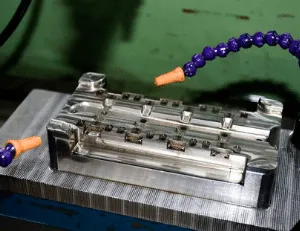
Surface treatment can significantly improve die casting mold performance, but it cannot completely compensate for poor mold design. A well‑designed mold allows surface treatments to deliver their maximum benefits.
5.1 Cooling System Design
Proper cooling reduces thermal deformation, lowers crack risk, and helps maintain stable dimensions. A well‑designed cooling system helps maintain consistent temperature distribution and avoids localized hot spots.
5.2 Mold Geometry
Complex geometry influences heat distribution, coating uniformity, polishing accessibility, and wear concentration. Sharp corners often experience stress concentration and faster thermal fatigue. Appropriate corner radii and smooth transitions improve both mold durability and surface treatment reliability.
5.3 Mold Steel Selection
Common die casting mold steels include H13 (excellent thermal fatigue resistance), SKD61 (good toughness and heat resistance), and S136 (corrosion resistance and polishing quality). The same coating may produce different results depending on steel composition, hardness level, and heat treatment condition.
6. Common Mistakes When Applying Surface Treatment
Many mold failures are not caused by the surface treatment technology itself, but by incorrect application decisions.
- Choosing treatment only based on cost – a lower‑cost treatment may appear attractive initially but create higher costs during production through more frequent maintenance and downtime.
- Ignoring working conditions – different die casting applications create different failure mechanisms; a treatment suitable for one mold may fail in another environment.
- Applying coating without proper surface preparation – poor preparation may cause weak coating adhesion, peeling, cracking, or uneven coating thickness.
- Coating before solving mold design problems – surface coating cannot fix poor cooling design, incorrect mold material, or excessive injection parameters.
- Using the same treatment for every mold component – different mold areas (cavity surface, core inserts, slides) experience different stresses and require different solutions.
- Ignoring coating thickness and dimensional impact – precision molds often contain tight dimensional requirements; coating thickness must be considered.
- Neglecting post‑treatment inspection – hardness testing, coating thickness measurement, adhesion testing, and surface inspection should verify treatment quality.
7. How Should Buyers Evaluate a Die Casting Mold Supplier?
Selecting a die casting mold supplier is not only about comparing mold prices. A supplier with strong engineering capability can help customers avoid problems before production begins.
Mold design capability – DFM analysis and structure optimization
Manufacturing equipment – CNC, EDM, grinding, polishing
Material knowledge – correct steel selection for the application
Surface treatment expertise – failure analysis and coating selection
Quality control – CMM, inspection systems, trial support
Industry experience – relevant application history
After‑sales support – maintenance and troubleshooting
7.1 Questions to Ask a Die Casting Mold Supplier
- Can you provide DFM analysis?
- How do you select mold steel?
- What machining processes are available?
- Which surface treatment is suitable and why?
- What inspection methods are used?
- Do you support mold trial and optimization?
8. Frequently Asked Questions
Why do die casting molds need surface treatment?
Die casting molds operate under high temperature cycles, high injection pressure, molten metal erosion, and repeated thermal stress. Without proper surface protection, molds experience wear, cracking, metal sticking, corrosion, and surface damage. Surface treatment improves hardness, wear resistance, thermal fatigue resistance, release performance, and surface quality.
What is the best surface treatment for aluminum die casting molds?
There is no single best treatment – it depends on mold steel, casting alloy, production volume, failure mode, and surface requirements. Common solutions include nitriding (wear resistance), PVD coating (anti‑sticking), and heat treatment (thermal fatigue resistance).
Is PVD coating suitable for die casting molds?
Yes. PVD coatings such as TiN, TiAlN, CrN, and AlCrN are widely used to improve wear resistance, reduce friction, improve release performance, and extend maintenance intervals. However, PVD cannot replace proper mold design, correct steel selection, or appropriate heat treatment.
How does nitriding improve die casting mold life?
Nitriding creates a hardened surface layer that increases surface hardness, improves wear resistance, and enhances resistance to thermal fatigue. It is commonly applied to mold inserts, core components, and high‑stress areas.
Can surface treatment replace proper mold design?
No. Surface treatment improves mold performance, but it cannot solve fundamental design problems such as excessive thermal stress, uneven cooling, or difficult demolding. The best results come from combining good mold design, suitable mold material, correct heat treatment, and optimized surface treatment.
9. Conclusion
Die casting mold surface treatment plays an important role in controlling mold life, production stability, and part quality. The correct treatment method can help manufacturers reduce mold failure, improve casting consistency, lower maintenance frequency, and increase production efficiency.
However, surface treatment is not a single universal solution. The best choice depends on mold material, casting alloy, production conditions, failure mode, and quality requirements. A successful solution usually combines correct mold steel, proper heat treatment, suitable surface treatment, and accurate mold design.
The most effective surface treatment strategy is not simply the hardest coating – it is the treatment that matches the failure mechanism and production environment.
Need a Reliable Die Casting Mold Solution?
Selecting the correct mold material, machining process, heat treatment, and surface treatment requires engineering experience. Our team can support mold design optimization, material selection, CNC/EDM machining, surface treatment recommendations, and mold testing.Request a Free Project Review →
Turnaround within 48 hours. No obligation.
Disclaimer: This guide provides general technical information based on industry standards and engineering best practices. Actual results depend on specific materials, equipment, and production conditions. Always validate with trials and consult qualified engineers for project‑specific decisions.