
📌 Engineering Summary – Key Takeaways
- Precision mold accuracy is a system capability – not just machining tolerance. It depends on design, material, machining, heat treatment, assembly, and process control.
- DFM analysis prevents problems before machining – wall thickness, draft angle, gate location, and cooling design must be reviewed early.
- Critical processes include – high‑speed CNC, 5‑axis machining, EDM, wire EDM, grinding, polishing, and precision assembly.
- Precision molds achieve – ±0.005–0.01mm dimensional tolerance, Ra 0.05–0.4μm surface finish, and 500k–2M+ cycle stability.
- Quality control is continuous – process monitoring, CMM inspection, and mold trial validation are more valuable than final inspection alone.
- Efficiency can be improved – through DFM optimization, mold flow simulation, CNC/EDM optimization, standardization, automation, and digital management.
- Choose suppliers with full capability – DFM, design, machining, EDM, inspection, and trial support reduce project risk.
Bottom line: A precision mold is not defined only by how accurately it is machined. It is defined by how reliably it can produce consistent parts throughout its entire service life.
1. Why Precision Mold Processing Is Critical for Injection Mold Manufacturing
Injection molding is one of the most widely used manufacturing methods for producing plastic parts at scale. However, the quality, consistency, and production efficiency of injection molded parts are largely determined before the first plastic shot is produced – during the mold manufacturing stage.
The injection mold is not simply a tool for shaping plastic material. It is a precision manufacturing system that controls final part dimensions, surface appearance, assembly accuracy, production cycle time, and long-term manufacturing stability.
| Mold Processing Issue | Possible Production Impact |
|---|---|
| Incorrect cavity dimension | Plastic parts fail dimensional inspection |
| Poor surface finish | Visible defects on product appearance |
| Misalignment between core and cavity | Flashing and uneven parting lines |
| Poor cooling channel accuracy | Warpage and unstable cycle time |
| Incorrect mold fitting | Reduced mold life and maintenance issues |
Industry Insight: A precision mold is not only a machined steel component. It is a complete manufacturing system designed to maintain dimensional stability during thousands or millions of injection cycles.
2. What Is Precision Mold Processing and How Does It Work?
Precision mold processing refers to the manufacturing process of producing injection molds with highly accurate dimensions, complex geometries, and reliable operating performance through advanced machining and finishing technologies.
Unlike general machining, precision mold processing focuses on controlling dimensional accuracy, geometric tolerances, surface roughness, component fitting accuracy, and long-term mold durability.
2.1 Key Processes in Precision Mold Manufacturing
| Manufacturing Process | Main Function |
|---|---|
| CAD Design | Define mold structure and part requirements |
| DFM Analysis | Identify manufacturing risks before production |
| CNC Machining | Create main mold geometry |
| EDM Machining | Process complex cavities and hardened steel |
| Wire EDM | Produce high-precision profiles and narrow features |
| Grinding | Achieve tight dimensional accuracy |
| Polishing | Improve surface quality and appearance |
| Mold Assembly | Ensure component fitting and movement |
| Inspection | Verify final mold accuracy |
2.2 Three Key Standards for Precision Mold Manufacturing
| Precision Factor | Typical Requirement | Manufacturing Impact |
|---|---|---|
| Dimensional Accuracy | ±0.005mm~±0.01mm | Controls part consistency |
| Surface Finish | Ra 0.05~0.4μm | Determines appearance and demolding performance |
| Mold Stability | 500k~2M+ cycles | Ensures long-term production reliability |
3. Main Processes of Precision Mold Processing
3.1 Step 1: How Does Mold Design and Engineering Analysis Affect Precision?
Before machining begins, engineers analyze the product design and convert product requirements into a manufacturable mold structure. DFM analysis helps identify difficult machining areas, potential molding defects, mold structure risks, and manufacturing cost drivers.
| DFM Item | Why It Matters | Risk Without Optimization |
|---|---|---|
| Wall thickness | Controls cooling and shrinkage | Warpage, sink marks |
| Draft angle | Enables smooth demolding | Part sticking |
| Parting line | Determines mold structure | Flash and complexity |
| Gate location | Controls material flow | Weld lines, filling issues |
| Cooling layout | Maintains temperature balance | Dimensional variation |
3.2 Step 2: How Does CNC Machining Create Precision Mold Components?
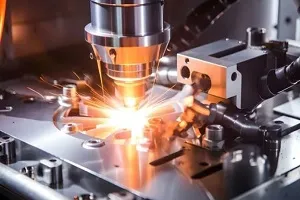
CNC machining is responsible for creating mold plates, core blocks, cavity blocks, inserts, and structural features. Modern CNC machining allows manufacturers to achieve complex three-dimensional mold geometries with high repeatability.
Key factors affecting CNC quality include machine rigidity, spindle accuracy, cutting tools, programming strategy, and cutting parameters.
3.3 Step 3: Why Is EDM Machining Essential for Precision Mold Processing?
EDM removes material through controlled electrical sparks rather than physical cutting, making it especially suitable for hardened tool steel, deep cavities, narrow slots, sharp internal corners, and complex mold details.
3.4 Step 4: How Does Wire EDM Improve Precision Mold Manufacturing?
Wire EDM uses a continuously moving thin wire electrode to cut through conductive materials, creating extremely narrow slots, complex profiles, sharp corners, and high-precision contours.
3.5 Step 5: How Does Grinding Improve Precision Mold Accuracy?
Grinding improves dimensional accuracy, flatness, parallelism, and surface finish after heat treatment, CNC machining, or EDM processing.
3.6 Step 6: Why Is Mold Polishing Important for Injection Mold Quality?
The surface condition of a mold directly transfers to the final molded product. Polishing improves product appearance, demolding performance, and surface texture consistency.
4. Characteristics of Precision Mold Processing
4.1 High Dimensional Accuracy and Tight Tolerance Control
Precision molds require extremely accurate dimensions because the mold cavity and core directly determine final part dimensions. Important controlled dimensions include cavity size, core position, insert location, parting surface, and guide system.
4.2 Ability to Manufacture Complex Geometries
Modern products require curved surfaces, thin-wall structures, micro features, deep ribs, precision inserts, and moving mechanisms. Precision processing combines CNC milling, EDM, grinding, and polishing to handle these complex features.
4.3 Multi-Process Manufacturing Integration
Precision molds cannot be completed by one machining technology. Different processes solve different challenges: CNC creates basic geometry, EDM produces complex cavities, grinding improves dimensional accuracy, and polishing improves surface quality.
4.4 High Repeatability During Mass Production
Precision molds must maintain consistent performance throughout thousands or millions of production cycles through accurate mold alignment, stable mold components, and controlled surface quality.
5. What Factors Affect Precision Mold Processing Accuracy?
| Factor | Influence on Mold Quality |
|---|---|
| Mold material | Determines stability and wear resistance |
| CNC equipment | Controls machining precision |
| Cutting tools | Affects surface quality and accuracy |
| Machining parameters | Controls vibration and deformation |
| Heat treatment | Influences dimensional stability |
| Environment | Reduces external accuracy variation |
| Engineering experience | Ensures optimized manufacturing decisions |
Key insight: Precision mold accuracy is not achieved by a single technology. It is the result of combining correct material selection, advanced machining capability, optimized manufacturing processes, and strict quality control.
Whether you are developing a new product or improving an existing mold, our engineering team can provide DFM analysis, mold design, precision machining, and trial support to ensure stable mass production.Request a Free Project Review →
6. How Is Precision Mold Quality Controlled?
A professional precision mold manufacturing process requires quality control throughout the entire workflow: material inspection → machining process monitoring → component measurement → mold assembly verification → trial injection validation → final approval.
6.1 Inspection Equipment
| Equipment | Purpose |
|---|---|
| CMM | Dimensional verification, position accuracy, complex geometry |
| Optical measurement | Small features, complex profiles, surface inspection |
| Surface roughness tester | Finish evaluation |
| Hardness tester | Material verification |
6.2 Trial Injection Validation
Even a dimensionally accurate mold must be validated under actual molding conditions. Trial production verifies filling performance, part dimensions, surface appearance, and ejection performance.
7. Common Precision Mold Manufacturing Problems and Solutions
| Problem | Main Causes | Solutions |
|---|---|---|
| Dimensional errors | Machine deviation, tool wear | Calibration, compensation, inspection |
| Surface defects | Wrong parameters, poor polishing | Process optimization, finishing control |
| Mold deformation | Internal stress, heat treatment | Stress relief, proper machining sequence |
| Assembly issues | Poor fitting, tolerance problems | Precision measurement, trial verification |
| Tool wear | Wrong tools, cutting conditions | Tool management, parameter optimization |
| Short mold life | Material selection, poor design | Better steel and maintenance |
8. How Can Manufacturers Improve Precision Mold Processing Efficiency?
- DFM analysis – Reduce design risks before manufacturing
- Mold flow simulation – Predict filling, cooling, and warpage
- Process optimization – Separate rough and finish machining
- CNC optimization – Optimize tool paths and cutting parameters
- EDM improvement – Use multiple EDM stages and optimize electrodes
- Standardization – Reduce repeated work with standard components
- Automation – Automated tool management and robotic loading
- Digital management – CAD/CAM integration and production tracking
9. Precision Mold Processing vs Standard Mold Processing
| Factor | Standard Mold Processing | Precision Mold Processing |
|---|---|---|
| Accuracy Requirement | General tolerance control | Strict dimensional and geometric tolerance |
| Machining Process | Conventional CNC machining | CNC + EDM + grinding + precision finishing |
| Mold Structure | Relatively simple | Complex cavity, inserts, sliders, micro features |
| Inspection Method | Basic measurement tools | CMM, optical measurement, surface inspection |
| Surface Requirement | Standard finish | Mirror finish or special texture |
| Application | General plastic products | Automotive, medical, electronics |
| Mold Cost | Lower | Higher |
| Production Stability | Moderate | High |
When to choose precision mold processing: Product requires tight tolerance, production volume is high, plastic material is difficult to process, or surface appearance is critical.
10. What Industries Require Precision Mold Processing?
| Industry | Main Mold Requirements | Typical Components |
|---|---|---|
| Automotive | Long life, stable production, complex structures | Interior parts, connectors, functional assemblies |
| Medical | High repeatability, cleanliness, precision | Syringe components, device housings, lab consumables |
| Electronics | Small features, appearance quality, tight tolerance | Connectors, housings, micro parts |
| Industrial Equipment | Strength, durability, reliability | Equipment housings, gears, structural parts |
| Aerospace | High accuracy, strict process control | Interior components, electronic housings |
11. How to Select a Precision Mold Processing Supplier
Engineering capability – DFM analysis and design optimization
CNC machining – high-speed and multi-axis capability
EDM – sinker, wire, and mirror EDM for complex features
Quality inspection – CMM, surface testers, material verification
Industry experience – similar project history
Trial molding support – validation and adjustment
Quality documentation – material certificates, inspection reports
Communication – fast response and technical problem-solving
11.1 Supplier Evaluation Checklist
| Evaluation Category | Key Questions |
|---|---|
| Engineering Capability | Can they provide DFM analysis? |
| CNC Capability | Can they machine complex mold components? |
| EDM Capability | Can they process hardened steel and details? |
| Inspection Capability | Do they have CMM and measurement systems? |
| Industry Experience | Have they handled similar projects? |
| Communication | Can they support technical discussions? |
| After-Sales Support | Can they solve production issues? |
12. Frequently Asked Questions
What tolerance can precision molds achieve?
Standard molds: ±0.02–0.05mm; precision molds: ±0.005–0.01mm; high‑precision applications may reach micron level for specific features.
How long does precision mold manufacturing take?
Typically 4–12 weeks depending on complexity, cavity count, and surface finish requirements.
Why is a precision mold more expensive?
Advanced CNC/EDM, longer inspection, better materials, and engineering optimization add cost – but reduce long‑term production risks.
How many cycles can a precision mold last?
Prototype molds: 1k–10k; low‑volume: 50k–300k; production precision molds: 500k–2M+ cycles with proper maintenance.
Why is EDM used in precision mold manufacturing?
EDM machines hardened steel and creates complex features (deep ribs, sharp corners, micro details) that CNC cannot easily produce.
What should buyers provide before requesting a quote?
3D CAD model, 2D drawing, material requirement, annual production volume, surface finish specification, and application details.
What is the difference between precision mold and standard mold?
Precision molds have tighter tolerances, complex structures, stricter inspection, and higher production stability – suitable for automotive, medical, and electronics applications.
13. Conclusion
Precision mold processing is not simply about machining accurate steel components. It is a complete engineering system that combines design, material science, machining, heat treatment, assembly, and quality control to achieve stable, repeatable production over long periods.
For industries where failure is expensive – automotive, medical, electronics, and aerospace – investing in precision mold manufacturing significantly reduces production risks, downtime, and long‑term costs.
The right precision mold manufacturer is not just a supplier – they are a partner who helps you achieve reliable mass production from design to delivery.
Need a Precision Mold Manufacturing Partner?
Whether you are developing a new product or improving an existing mold, our engineering team can provide DFM analysis, mold design, precision machining, and trial support to ensure stable mass production.Request a Free Project Review →
Turnaround within 48 hours. No obligation.
Disclaimer: This guide provides general technical information based on industry standards and engineering best practices. Actual results depend on specific materials, equipment, and production conditions. Always validate with trials and consult qualified engineers for project-specific decisions.