
📌 Engineering Summary – Key Takeaways
- Precision mold accuracy is a system capability – not just machining tolerance. It depends on design, material, machining, heat treatment, assembly, and process control.
- DFM analysis prevents problems before machining – wall thickness, draft angle, gate location, and cooling design must be reviewed early.
- Critical processes include – high-speed CNC, 5‑axis machining, EDM, grinding, polishing, and precision assembly.
- Quality control is continuous – process monitoring and CMM inspection are more valuable than final inspection alone.
- Mold trial validates production stability – trial shots confirm filling, cooling, ejection, and part quality before mass production.
- Choose suppliers with full capability – DFM, design, machining, EDM, inspection, and trial support reduce project risk.
Bottom line: A precision mold is not defined only by how accurately it is machined. It is defined by how reliably it can produce consistent parts throughout its entire service life.
1. Why Does Precision Mold Processing Determine Injection Mold Quality?
Many buyers assume that a high-end CNC machine automatically produces a high-quality precision mold. In reality, mold performance depends on the entire manufacturing system:
Product Design → DFM Analysis → Mold Engineering → Material Selection → Machining Process → Heat Treatment → Assembly → Inspection → Trial Production → Mass Production
A mistake in an early stage can create problems that appear later: dimensional instability, flash, short mold life, difficult demolding, excessive maintenance, and higher production cost.
Industry Insight: A precision mold is not only a machined steel component. It is a complete manufacturing system designed to maintain dimensional stability during thousands or millions of injection cycles.
2. What Is Precision Mold Processing and How Is Precision Defined?
Precision mold processing is the complete manufacturing process of producing injection molds with high dimensional accuracy, excellent surface quality, and long-term production stability.
2.1 Three Key Standards for Precision Mold Manufacturing
| Precision Factor | Typical Requirement | Manufacturing Impact |
|---|---|---|
| Dimensional Accuracy | ±0.005mm~±0.01mm | Controls part consistency |
| Surface Finish | Ra 0.05~0.4μm | Determines appearance and demolding performance |
| Mold Stability | 500k~2M+ cycles | Ensures long-term production reliability |
3. What Is the Complete Precision Mold Processing Process?
3.1 Step 1: How Does DFM Analysis Improve Precision Mold Quality?
DFM (Design for Manufacturing) analysis evaluates part design before machining to prevent defects.
| DFM Item | Why It Matters | Risk Without Optimization |
|---|---|---|
| Wall thickness | Controls cooling and shrinkage | Warpage, sink marks |
| Draft angle | Enables smooth demolding | Part sticking |
| Parting line | Determines mold structure | Flash and complexity |
| Gate location | Controls material flow | Weld lines, filling issues |
| Cooling layout | Maintains temperature balance | Dimensional variation |
| Mold opening direction | Defines mechanism design | Increased mold cost |
Key insight: Machining accuracy alone cannot compensate for poor product design. DFM review is essential.
3.2 Step 2: How Does Mold Design Affect Final Precision?
Precision mold design must consider shrinkage compensation and cooling system optimization. Different materials shrink differently:
| Material | Shrinkage Characteristics |
|---|---|
| ABS | Moderate shrinkage |
| PP | Higher shrinkage |
| PC | Lower shrinkage but sensitive to stress |
| Glass-filled materials | Different shrinkage direction |
Cooling design directly affects cycle time, dimensional stability, and mold lifetime. Uneven cooling causes part deformation, longer cycles, and dimension drift.
3.3 Step 3: How Are Mold Components Machined with CNC Technology?
CNC milling creates cavities, cores, inserts, and complex surfaces. Five‑axis machining reduces setups and improves accuracy for deep cavities and complex curves.
Hard milling (machining pre‑hardened steel) reduces EDM dependency, shortens lead time, and improves surface consistency.
3.4 Step 4: Why Is EDM Machining Essential?
EDM (Electrical Discharge Machining) is necessary for deep narrow ribs, sharp internal corners, and complex cavities that CNC cannot easily reach. Types include sinker EDM, wire EDM, and mirror EDM.
3.5 Step 5: How Do Grinding and Polishing Improve Mold Performance?
Surface finish affects part release, appearance, and mold lifetime. Requirements range from EDM texture for functional surfaces to mirror finish for optical components.
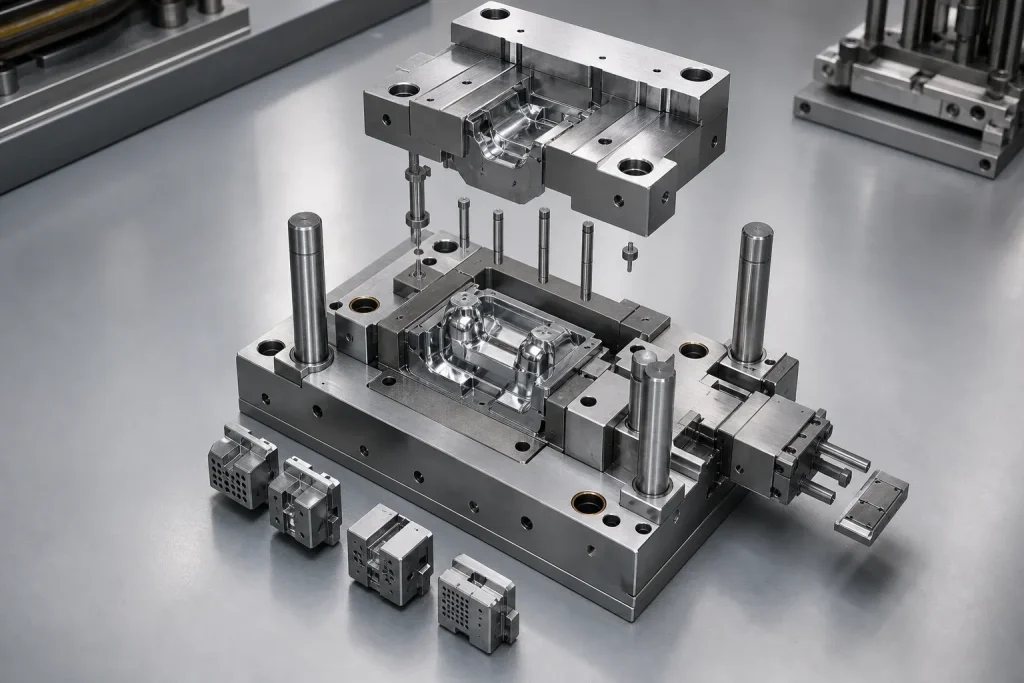
3.6 Step 6: How Are Precision Molds Assembled and Validated?
Assembly verifies cavity/core alignment, slider movement, and ejector balance. Mold trial checks dimensions, filling, cooling, and ejection stability. Adjustments are made before mass production.
4. What Are the Main Characteristics of Precision Mold Processing?
4.1 Extremely High Dimensional Accuracy
Mold errors are replicated onto plastic parts. For connectors and medical components, ±0.005mm accuracy is common.
4.2 Complex Geometry Capability
Precision molds handle thin walls, micro features, and multi‑slider mechanisms, requiring integrated CNC, EDM, and grinding.
4.3 Process Integration
Full‑service manufacturers combine design, machining, EDM, grinding, polishing, assembly, and inspection in one workflow to reduce communication errors.
4.4 Long‑Term Production Stability
Stability depends on steel quality, heat treatment, cooling design, and maintenance planning. Production precision molds typically last 500k–2M+ cycles.
4.5 Strict Process Control
Temperature control, tool wear monitoring, and measurement feedback are essential to maintain consistency.
5. What Factors Affect Precision Mold Processing Accuracy?
- Mold steel selection – P20, 718H, NAK80, S136, H13 each suit different applications.
- CNC machine capability – rigidity, spindle accuracy, and multi‑axis capability.
- Manufacturing environment – temperature control reduces measurement variation.
- Cutting parameters – speed, feed, depth of cut, and tool condition affect surface and dimension.
- Heat treatment – vacuum heat treatment and stress relief reduce deformation.
- Engineering experience – experienced engineers optimize sequences and predict issues.
- Inspection system – CMM and in‑process measurement ensure dimensional compliance.
Whether you are developing a new product or improving an existing mold, our engineering team can provide DFM analysis, mold design, precision machining, and trial support to ensure stable mass production.Request a Free Project Review →
6. How Do Manufacturers Control Precision Mold Quality?
6.1 Inspection Equipment
| Equipment | Purpose |
|---|---|
| CMM | Dimensional verification |
| Optical measurement | Complex geometry inspection |
| Surface roughness tester | Finish evaluation |
| Hardness tester | Material verification |
Process control (material verification, parameter monitoring, and component matching) is more important than final inspection alone. Mold trial validates performance before mass production.
7. What Are Common Precision Mold Manufacturing Problems and How Can They Be Solved?
| Problem | Root Cause | Solution |
|---|---|---|
| Heat treatment deformation | Internal stress, improper process | Stress relief, vacuum heat treatment, machining allowance |
| Surface defects (EDM marks, uneven polish) | Incorrect EDM parameters, poor polishing | Optimize EDM, follow proper polishing sequence |
| Dimensional variation during production | Thermal expansion, uneven cooling, wear | Improve cooling, use wear‑resistant inserts, preventive maintenance |
| Mold trial failures | Poor gate, cooling imbalance, wall thickness issues | DFM review, gate and cooling optimization, mold fitting adjustment |
| Short mold life | Poor material, incorrect heat treatment, lack of maintenance | Select correct steel, proper heat treatment, scheduled maintenance |
8. Which Industries Need Precision Mold Processing?
Industries requiring tight tolerances, high volume, and strict quality include:
- Automotive – connectors, interior components, sensors – require ±0.005–0.01mm accuracy and long tool life.
- Medical – housings, consumables, surgical parts – demand repeatability and surface cleanliness.
- Electronics – connectors, switches, micro parts – need precise cavities and tiny features.
- Optical – lenses, light guides – require mirror‑finished surfaces.
- Consumer electronics – thin‑wall housings with cosmetic surfaces.
- Industrial equipment – functional components requiring durability.
9. How Should Buyers Select a Precision Mold Manufacturer?
Evaluate suppliers based on:
DFM capability – engineering feedback before manufacturing
Mold design experience – complex structures and cooling optimization
CNC machining – high‑speed and multi‑axis capability
EDM – sinker, wire, and mirror EDM for complex features
Quality inspection – CMM, surface testers, material verification
Trial molding support – validation and adjustment
Quality documentation – material certificates, inspection reports, trial records
Communication – fast response and technical problem‑solving
Red flags: suppliers who focus only on low price, cannot explain their process, or avoid trial validation.
10. Frequently Asked Questions
What tolerance can precision molds achieve?
Standard molds: ±0.02–0.05mm; precision molds: ±0.005–0.01mm; high‑precision applications may reach micron level for specific features.
How long does precision mold manufacturing take?
Typically 4–12 weeks depending on complexity, cavity count, and surface finish requirements.
Why is a precision mold more expensive?
Advanced CNC/EDM, longer inspection, better materials, and engineering optimization add cost – but reduce long‑term production risks.
How many cycles can a precision mold last?
Prototype molds: 1k–10k; low‑volume: 50k–300k; production precision molds: 500k–2M+ cycles with proper maintenance.
Why is EDM used in precision mold manufacturing?
EDM machines hardened steel and creates complex features (deep ribs, sharp corners, micro details) that CNC cannot easily produce.
What should buyers provide before requesting a quote?
3D CAD model, 2D drawing, material requirement, annual production volume, surface finish specification, and application details.
11. Conclusion
Precision mold processing is not simply about machining accurate steel components. It is a complete engineering system that combines design, material science, machining, heat treatment, assembly, and quality control to achieve stable, repeatable production over long periods.
For industries where failure is expensive – automotive, medical, electronics, optics – investing in precision mold manufacturing significantly reduces production risks, downtime, and long‑term costs.
The right precision mold manufacturer is not just a supplier – they are a partner who helps you achieve reliable mass production from design to delivery.
Need a Precision Mold Manufacturing Partner?
Whether you are developing a new product or improving an existing mold, our engineering team can provide DFM analysis, mold design, precision machining, and trial support to ensure stable mass production.Request a Free Project Review →
Turnaround within 48 hours. No obligation.
Disclaimer: This guide provides general technical information based on industry standards and engineering best practices. Actual results depend on specific materials, equipment, and production conditions. Always validate with trials and consult qualified engineers for project-specific decisions.