
Integrated composite structure, multiple manufacturing requirements
Carbon fiber-reinforced nylon is not only used for prototyping but can also serve as a functional structural matrix for automated equipment that can be directly installed, making it suitable for the production and manufacturing of various dynamic moving components.XinXiu Precision has successfully manufactured a carbon fiber-reinforced nylon robotic joint component for a client. The main body of the part is made of PA12-CF carbon fiber-reinforced nylon (carbon fiber-filled PA12) and was produced as a single, integrated piece via SLS (Selective Laser Sintering). As a core moving component of the robotic arm, this structure primarily performs multi-dimensional motions such as swinging and rotating, while also providing precise positioning and assembly references for end-effectors such as grippers and sensors.The manufacturing challenges of this project lie not only in the precise formation of complex openwork topologies and irregularly shaped rib surfaces, but also—and most critically—in the precise control of movement clearances and mounting references at multi-directional articulation points, ensuring the joint’s long-term flexibility, smooth operation, and freedom from jamming or abnormal noises. The Xinshou team integrated complex-surface SLS 3D printing with precision post-processing into a coordinated manufacturing workflow, enabling the components to simultaneously achieve lightweight load-bearing capacity, high-strength support, and highly flexible motion characteristics, thereby providing a reliable foundation for the stable assembly and operation of the entire robotic arm module.
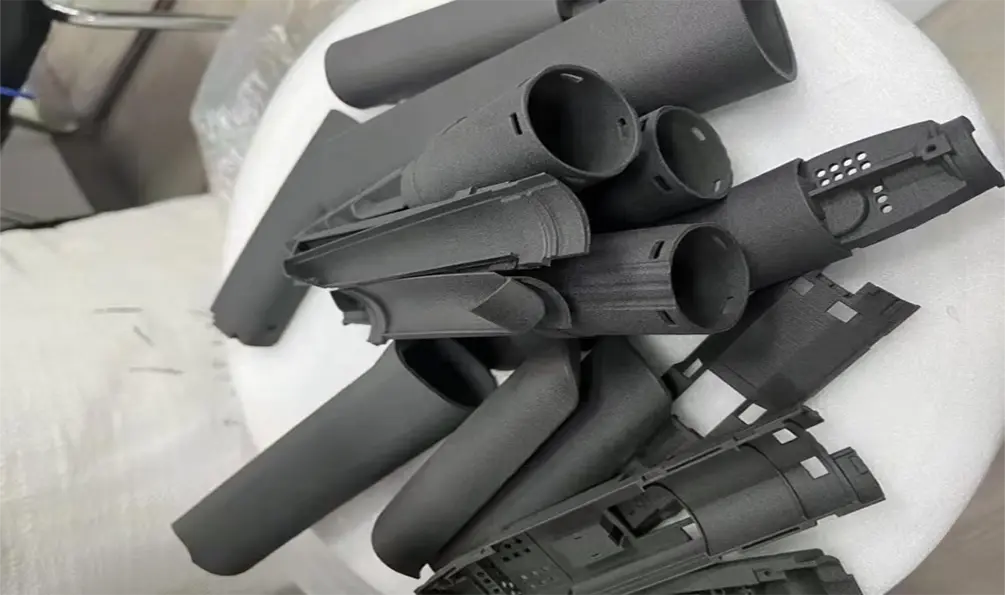
Carbon fiber-reinforced nylon is not only used for prototyping but can also serve as a functional structural matrix for automated equipment that can be directly installed, making it suitable for the production and manufacturing of various dynamic moving components.Xinshou Precision has successfully manufactured a carbon fiber-reinforced nylon robotic joint component for a client. The main body of the part is made of PA12-CF carbon fiber-reinforced nylon (carbon fiber-filled PA12) and was produced as a single, integrated piece via SLS (Selective Laser Sintering). As a core moving component of the robotic arm, this structure primarily performs multi-dimensional motions such as swinging and rotating, while also providing precise positioning and assembly references for end-effectors such as grippers and sensors.The manufacturing challenges of this project lie not only in the precise formation of complex openwork topologies and irregularly shaped rib surfaces, but also—and most critically—in the precise control of movement clearances and mounting references at multi-directional articulation points, ensuring the joint’s long-term flexibility, smooth operation, and freedom from jamming or abnormal noises. The Xinshou team integrated complex-surface SLS 3D printing with precision post-processing into a coordinated manufacturing workflow, enabling the components to simultaneously achieve lightweight load-bearing capacity, high-strength support, and highly flexible motion characteristics, thereby providing a reliable foundation for the stable assembly and operation of the entire robotic arm module.
Robotic joints are components subjected to high-frequency reciprocating motion under severe operating conditions. They must simultaneously meet multiple requirements, including flexible movement across multiple degrees of freedom, sustained load-bearing capacity at articulation points, overall lightweight design, and long-term resistance to fatigue deformation.While conventional pure PA12 nylon offers the advantages of low water absorption and dimensional stability, its structural strength and rigidity are insufficient to withstand dynamic loading conditions. In contrast, PA12-CF carbon fiber-reinforced nylon—modified by adding carbon fibers to the PA12 matrix—achieves a perfect balance of performance characteristics, making it well-suited for the reciprocating motion of robotic joints. Typical material specifications include: maximum water absorption of 0.4%, tensile strength of approximately 88 MPa, heat deflection temperature of 165°C, and flexural modulus of 6,000 MPa.Leveraging the core advantages of SLS (Selective Laser Sintering) powder-bed support-free printing, it is possible to directly print hollow, weight-reduced structures, irregularly shaped reinforcing ribs, and complex articulated surfaces as a single, integrated part. This eliminates the need to split the part into multiple components for assembly, thereby avoiding cumulative assembly errors at the process source and ensuring smooth, flexible joint movement and sensitive responsiveness to the greatest extent possible.
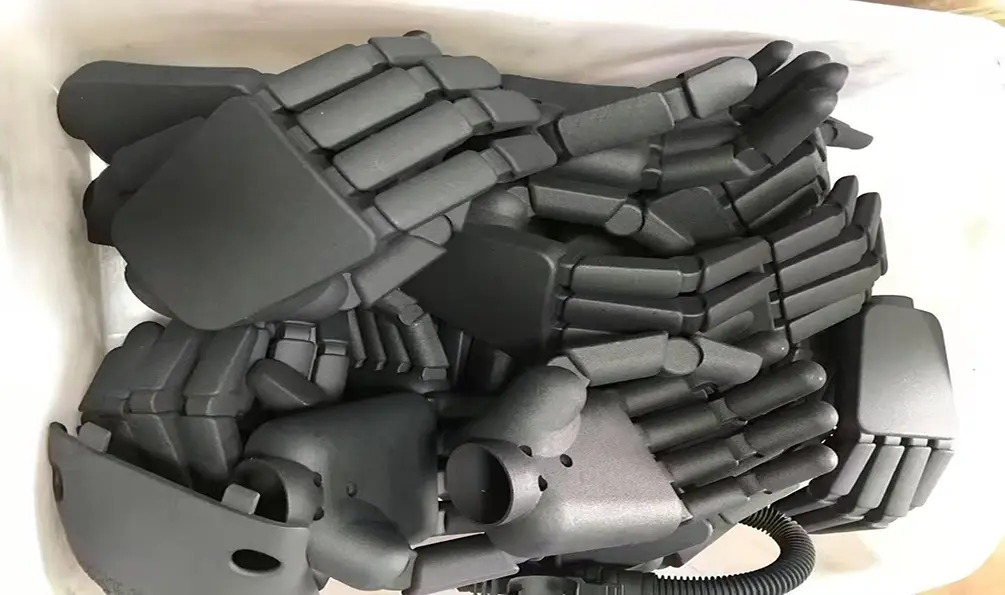
For this high-precision motion joint component, Xinshou Precision integrated the part’s motion characteristics with assembly requirements to develop a customized, integrated manufacturing process combining PA12-CF carbon-fiber-reinforced nylon SLS printing with precision post-processing, balancing forming accuracy, structural strength, and motion clearance precision.The printing process precisely forms the topological reinforcement structure, core hinge positioning references, and distributed hinge mounting holes in a single pass; Subsequent standardized powder removal and sandblasting precision post-processing meticulously control the articulation clearance, completely eliminating stuttering issues and ensuring smooth, flexible joint rotation. These two processes are highly interdependent and managed holistically; assembly tolerances for every articulation hole and moving mating surface are strictly controlled. As a core manufacturing step, post-processing effectively protects the part’s base structure and prevents any deviation from reference positions.Complete manufacturing process for this project:
1. The main body is 3D printed using SLS (Selective Laser Sintering) with PA12-CF carbon fiber-reinforced nylon powder;
2. SLS printing produces a monolithic, complex ribbed-hollow topology with multiple sets of hinged positioning references;
3. Standardized debinding and sandblasting precision post-processing precisely control hinge clearance to ensure flexible joint movement;
4. The finished component integrates multiple functions in a single unit, including repetitive load-bearing, lightweight design, multi-degree-of-freedom articulation, and precise assembly reference points;
5. Leveraging the properties of PA12-CF material, the part features low water absorption, high mechanical strength, heat resistance, and fatigue resistance, making it suitable for continuous repetitive motion in equipment operations.
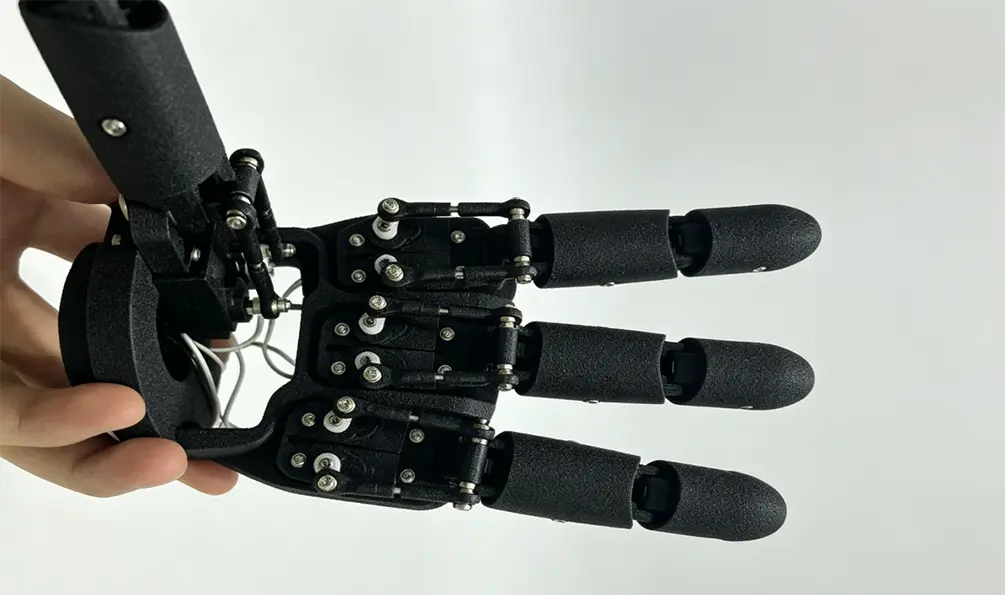
In the later stages of the project, comprehensive accuracy verification and assembly testing will be conducted to precisely measure critical part dimensions, hinge reference accuracy, and motion clearance. The entire unit will be assembled and debugged to fully verify the flexibility of joint rotation and operational stability.For equipment designed for special operating conditions—where joint components must endure prolonged exposure to vibration, temperature cycling, and high-frequency reciprocating motion—we will conduct complete system assembly testing and environmental reliability validation in accordance with industry application standards to ensure the product’s long-term stable service life.
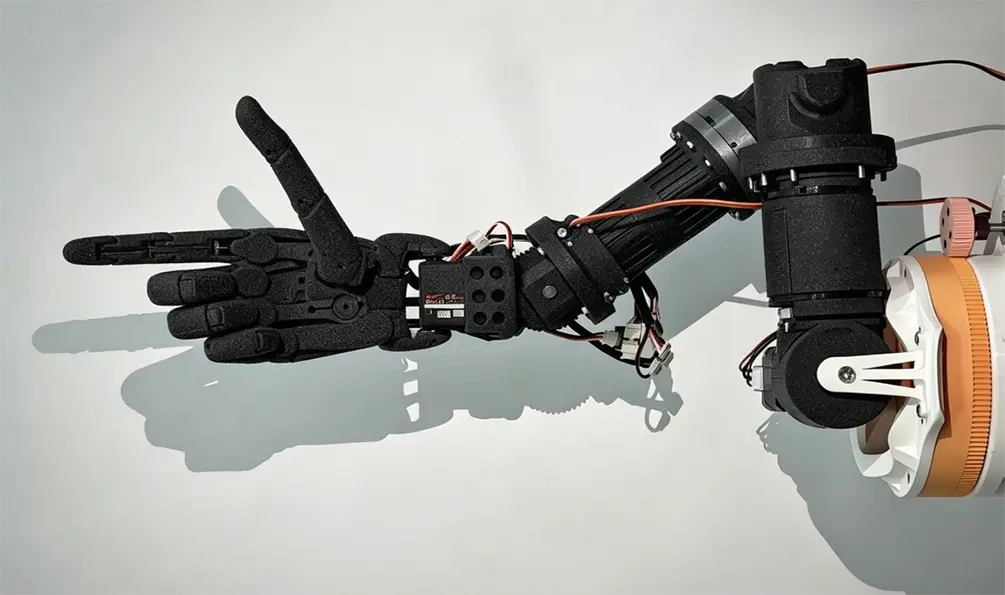
Scope of Application and Wide-Ranging Use Cases
The process advantages of integrated 3D printing with PA12-CF carbon fiber-reinforced nylon are not limited to robotic joint components. In all electromechanical systems, this process can be applied to parts that require a balance of lightweight design, structural strength, articulated motion, complex irregular shapes, and stable assembly. The finished products can be installed directly into equipment and are by no means limited to prototype validation.
These products are widely used in the following applications:
Robotic automation equipment — robotic arm joints, swing adapters, gripper bases, sensor mounts, lightweight tooling and fixtures
Aerospace Electronics — Avionics Module Support Components, Insulation Barriers, and Lightweight Movable Mounting Structures
Electrical Equipment — Insulated Frames, Terminal Mounting Plates, Support Brackets for Moving Load-Bearing Components
Industrial Electronic Systems — Sensor Mounts, Support Brackets for Testing Equipment, Precision Custom Structural Components
If your project also requires carbon fiber-reinforced nylon materials, SLS printing of complex articulated surfaces, and integrated joints that balance structural strength with motion flexibility, what matters most to you: the precision of articulated surface formation, the accuracy of clearance control, or the overall motion stability of the machine?
Contact Xinshou Precision to discuss your drawings and project requirements.