
“Through XINXIU Technology, we’ve found a manufacturing partner that supports our development philosophy. The ability to quickly and accurately validate our products across the entire process—from drawings to prototypes to mass production—allows us to continuously iterate and optimize our LED moving head lights. This flexibility is crucial to our innovation process.”
Rodja Trappe
Founder and CEO, BRDE
Early Validation Amid Cost Pressures
Compact stage lighting modules: How can we quickly complete proof-of-concept while strictly controlling costs without slowing down product iteration?
This product iteration involves the BRDE series of multi-power LED stage lighting modules, which are primarily used in commercial entertainment moving head lights. The product features a precision-engineered structure with strict requirements for assembly fit, optical alignment accuracy, and interchangeability across multiple models.
The client faced two major challenges in the early stages of R&D: the high cost and significant risk associated with direct mold-making and trial-and-error testing; and the complexity of coordinating with multiple suppliers across dispersed overseas manufacturing processes, resulting in long iteration cycles and high coordination costs. The client required a low-cost, fast-paced, end-to-end validation solution.
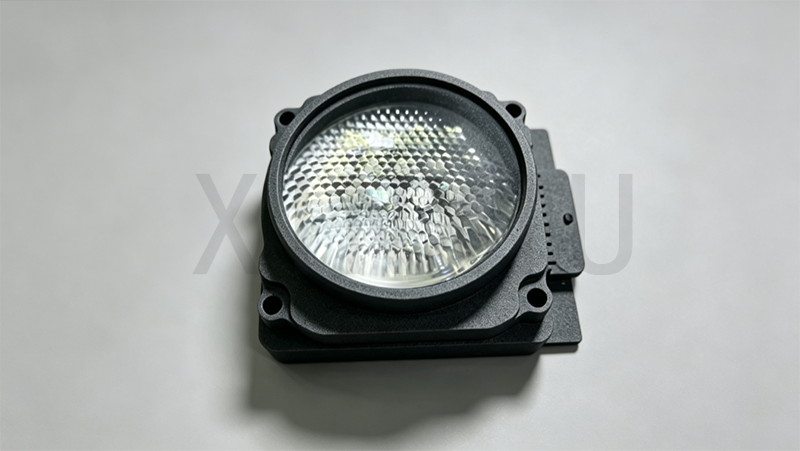
XINXIU Phased Prototype Validation Solution
We have customized a full-chain, one-stop validation process: “3D-printed rapid prototyping → CNC-machined precision aluminum parts + vacuum casting of pre-production samples → standardized mass production machining.” A single factory handles all processes, eliminating coordination losses between multiple parties. By conducting multi-specification light source module testing in phases, we significantly reduce the risk associated with large upfront investments in molds.
Phase 1: 3D-Printed Rapid Prototyping—Initial Structural Validation for Multiple Specifications Completed in 5–7 Days
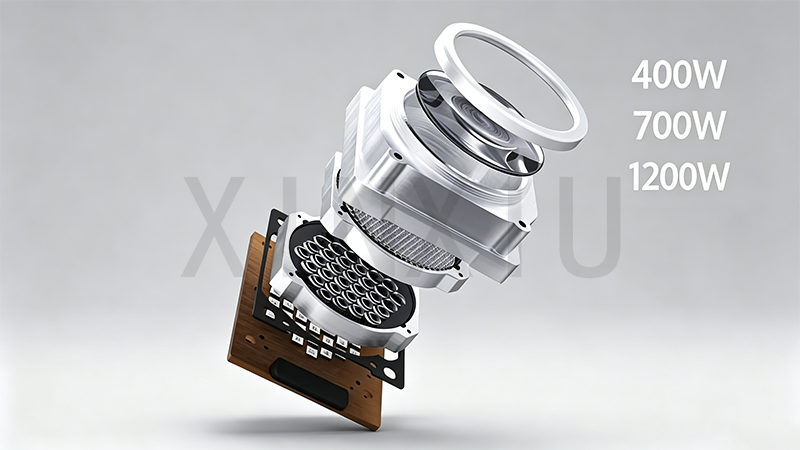
In the early stages of the project, we simultaneously develop three light source structures—400W, 700W, and 1200W—using industrial-grade 3D printing to produce a complete set of structural components, including a one-piece heat-dissipating housing, lens retaining rings, and positioning bases.
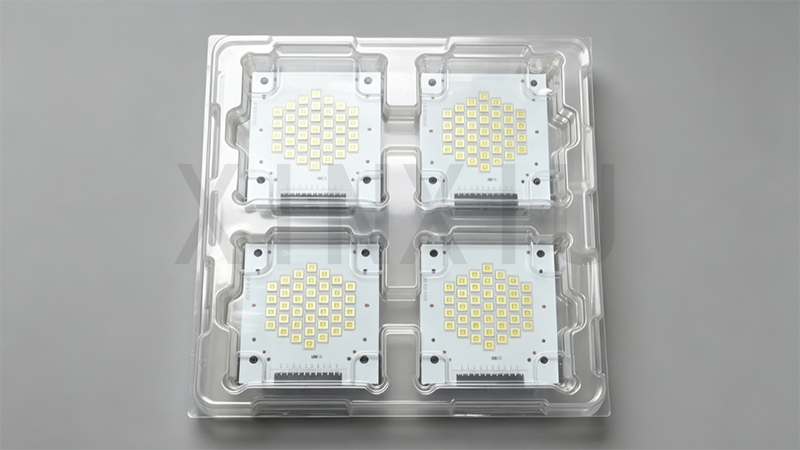
Without the need for tooling, fully assemblable physical prototypes were rapidly produced to quickly verify the installation space for internal LED boards, lens assembly clearances, heat dissipation channel layouts, and the overall unit’s sealing structure, thereby swiftly eliminating fundamental issues such as design interferences and dimensional misalignments. The printed prototypes were structurally robust, allowing for direct optical alignment and basic assembly testing, while simultaneously comparing the dimensional differences among the three power module variants.
Key advantages of this phase: A single-cycle structural validation period of just 5–7 days, with simultaneous iteration across multiple models, thereby avoiding later mold rework losses from the outset.
Phase Two: CNC Precision Machining + Vacuum Casting, Simulating Mass-Production-Level Assembly Testing
Once the basic structural design is finalized, the process moves to high-precision mass-production simulation validation, with a combination of two processes tailored to different component requirements:
CNC Precision Machining: For core precision-fit components such as aluminum alloy heat sink housings, lens positioning rings, and mounting定位 tabs, dimensional tolerances are strictly controlled to replicate the rigidity of mass-produced metal materials. This significantly reduces the number of assembly and debugging reworks, lowering the frequency of repeated adjustments by 30% and resolving issues such as lens misalignment, loose LED board adhesion, and heat sink assembly jamming;
Vacuum Casting Process: This process is used to mass-produce cosmetic components such as sealed outer casings and light-transmitting retaining rings. It ensures consistency in surface profiles, dimensions, and appearance across multiple batches. Without the need for molds, 10–15 complete light source modules can be produced in a single run, enabling interchangeable assembly across different power models and simulating long-term heat dissipation under continuous power-on conditions.
This phase fully validates universal installation standards for multiple light source modules and locks in mass-production assembly parameters in advance, eliminating the need for upfront investment in aluminum die-casting or plastic injection molds.
Phase Three: Seamless Transition to Mass Production and Implementation of Standardized Light Source Modules
Following multiple rounds of prototype iterations, power-on thermal durability testing, and cross-specification assembly validation, the light source module’s structure, optical parameters, and assembly standards have been fully finalized. We simultaneously provide a complete set of validation data, machining benchmarks, and assembly specifications to assist customers in a smooth transition to mass production via aluminum alloy CNC machining and plastic injection molding. This helps proactively avoid risks associated with mass production, such as assembly defects, thermal management failures, and optical misalignment—which could lead to batch scrapping—ensuring a seamless transition from prototype validation to mass production delivery.
Quantification of Project Benefits
By leveraging XINXIU’s one-stop, phased validation system, customers achieve comprehensive optimization in terms of cost, timeline, and collaboration efficiency, with quantifiable benefits:
✅ Overall early-stage development costs for light source modules are reduced by 40%; multiple models are developed simultaneously, cutting upfront mold investment risks and costs by 50%;
✅ The overall decision-making cycle—from prototype design approval to mold production and mass production—is shortened by 3 weeks;
✅ With 3D printing rapid prototyping, the first round of simultaneous structural validation for three power light source models takes only 5–7 days;
✅ Supported by CNC precision metal machining, the number of iterative adjustments during part assembly was reduced by 30%;
✅ Vacuum casting enabled batch assembly and live testing of 10–15 complete light source modules;
✅ End-to-end delivery by a single supplier reduced coordination and communication efforts across vendors and production stages by 60%.
General Application Scenarios for the Solution
This verification solution is suitable for the R&D of precision optoelectronic products across multiple industries.
. Stage lighting sources
. Consumer electronics light-emitting modules
. Medical optical components
. Industrial lighting modules
. Automotive lighting units
Addressing pain points faced by overseas brands—such as multi-step subcontracting, high tooling costs, and slow iteration cycles—XINXIU’s end-to-end, one-stop service streamlines the R&D process, shortens iteration cycles, and strictly controls trial-and-error costs, helping new products reach the market quickly.
Rodja Trappe
Founder and CEO
“By simply uploading CAD files, we can quickly obtain customized solutions for stage lighting modules. This significantly reduces R&D time, allowing us to rapidly iterate and repeatedly test optical and structural designs. We can also leverage this flexible manufacturing model to calculate the implementation costs of different processes and precisely optimize each generation of lighting products.”
“Another key advantage is the support for single-unit prototyping and small-batch customization. For BRDE, a smooth transition from R&D to mass production is crucial. We can validate the performance of new lighting modules at low cost and proceed to full-scale production only after confirming their stability, which significantly reduces the risks associated with product iterations.”