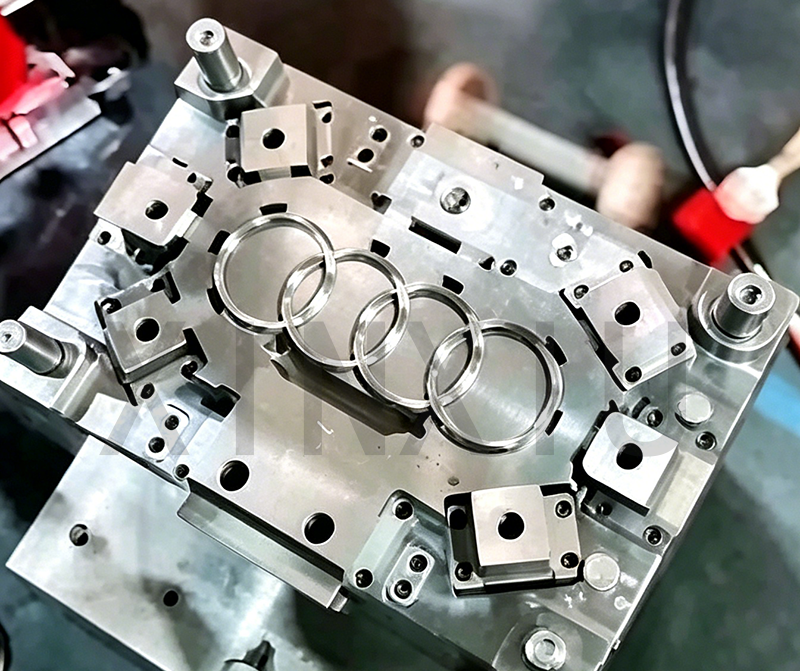
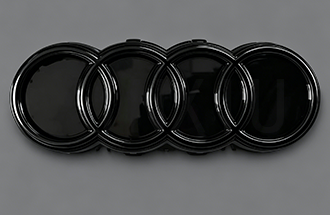
Project Name: Audi Logo Holder Tooling
Manufacturing Method: SLM Metal 3D Printing
Material Used: CORRAX Stainless Steel Mold Core
Maximum Accuracy: ±0.1 mm
Production Cycle: 7 days
Product Dimensions: 15 cm × 25 cm × 11 cm
When Design Meets Engineering Validation
XINXIU developed custom molds for the injection molding project of Audi’s logo mounting bracket. The core challenge of this project was to meet the client’s stringent mass production timeline requirements. At the outset of the project, the client explicitly stated the following mandatory mass production requirements: “The injection molding cycle time must be kept within 20 seconds to ensure the production line meets mass production capacity targets.” In the early stages of the project, traditional CNC-drilled linear cooling channel molds were tested. However, due to structural machining limitations, the cooling channels could not conform to the product’s complex curved surfaces and thick-walled areas, resulting in significant blind spots in heat dissipation. Actual testing showed that the maximum achievable molding cycle time was only 32 seconds, making it nearly impossible to meet the client’s 20-second mass production target using traditional processes. To address this technical challenge, XINXIU’s metal 3D printing solution—which enables one-step printing and direct implementation—provides a viable path to short-cycle mass production.
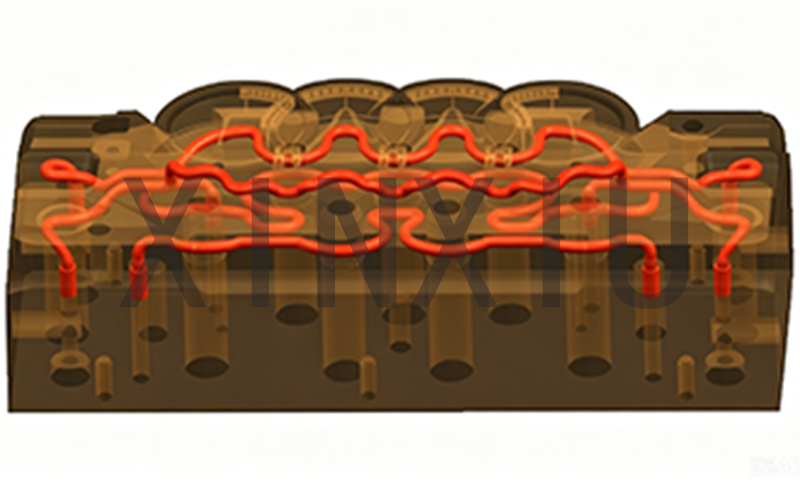
Engineering Controls Behind the Scenes
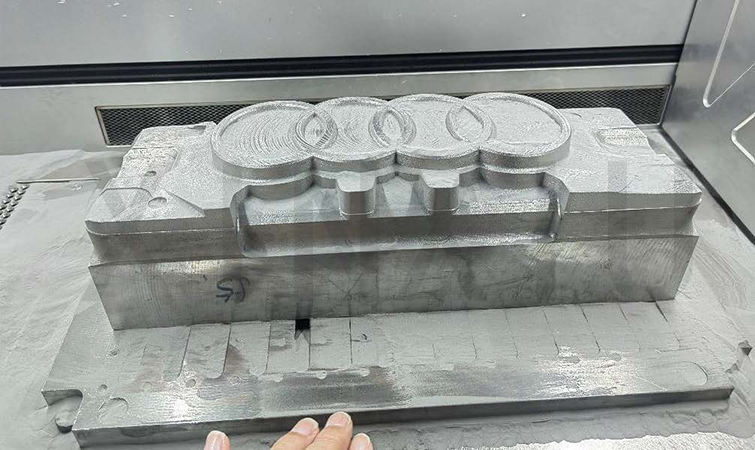
To precisely meet our client’s mass production requirements, our printing technology team utilized SLM metal 3D printing to create a CORRAX stainless steel mold core with an integrated, custom-shaped cooling channel. The cooling channels precisely follow the product’s surface contours and are strategically arranged in thick-walled hot spots, providing full coverage to eliminate heat dissipation blind spots and ensuring uniform cooling across the entire mold. Following mold flow optimization and on-machine trial runs, the optimized product’s molding cycle was consistently maintained at 24.8 seconds, with overall cooling efficiency improved by 21.7%. This perfectly met the client’s stringent mass production requirement of under 25 seconds, completely resolving the core issue of excessively long cycle times associated with traditional cooling channels. The entire core printing process took only 7 days, significantly shortening the mold R&D and trial-molding iteration cycles.
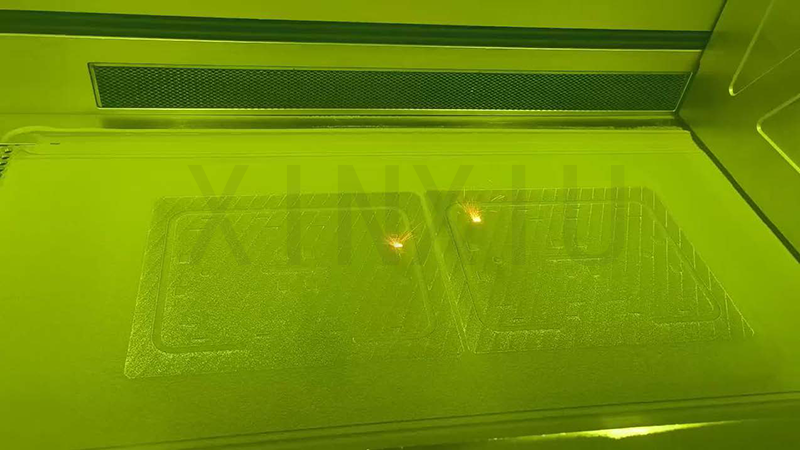
Printing Mold Cores
CORRAX steel is specifically designed for high-frequency, short-cycle mass production: with an initial hardness of 30–34 HRC, it can reach 48–50 HRC after heat treatment. It features high hardness, strong wear resistance, and excellent rust and corrosion resistance, ensuring that the integral cooling channels remain unobstructed over the long term. Its mass production stability far exceeds that of ordinary mold steel. Mold forming accuracy is controlled within ±0.1 mm, effectively ensuring dimensional consistency and assembly precision for automotive exterior components.
Mold Trial and Validation
After multiple rounds of mold testing, debugging, and small-batch production trials, the equipment has demonstrated stable operation. The product consistently maintains a stable molding cycle of 24.8 seconds, precisely meeting the customer’s established mass production standards. At the same time, it has completely eliminated appearance defects—such as shrinkage, warping, and deformation—caused by traditional processes, significantly improving product yield and production capacity. This project has fully demonstrated that, for high-precision automotive exterior components and short-cycle mass production requirements, CORRAX’s stainless steel 3D-printed conformal cooling cores can effectively overcome the bottlenecks of traditional mold manufacturing, representing the optimal mass production solution that balances high efficiency, high precision, and high stability.