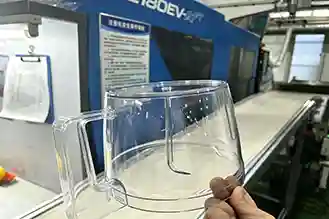
In precision injection molding, one of the most common questions customers ask is: How much dimensional accuracy can an injection molded part achieve?
There is no single tolerance value that applies to every plastic component. Material shrinkage, part geometry, mold accuracy, injection molding equipment, and process parameters can all affect the final dimensions. Therefore, specifying a very tight tolerance on a drawing does not automatically guarantee that the molded part will consistently achieve that tolerance.
For connectors, automotive components, medical products, electronic housings, and precision mechanical parts, reasonable tolerance requirements combined with appropriate mold design, machining, molding, and inspection are essential for stable dimensional performance.
1.What Are Injection Molding Dimensional Tolerances?
Dimensional tolerance defines the acceptable variation between the actual dimension of a part and its nominal design dimension.
For example, if a component has a nominal dimension of 50 mm with a tolerance of ±0.05 mm, the acceptable dimensional range is 49.95–50.05 mm.
For injection molded plastic parts, however, the final dimension is not determined by the mold dimension alone. Plastic materials change volume during melting, filling, packing, and cooling. As a result, material shrinkage and molding conditions have a direct influence on the final part size.
Precision injection molding should therefore be considered as a complete process covering product design, material selection, mold design, mold manufacturing, injection molding, and dimensional inspection.
2.Material Shrinkage Is a Key Factor in Dimensional Accuracy
Different plastics have different shrinkage characteristics.
Materials such as ABS, PC, POM, PA, and PEEK behave differently during molding. Glass-fiber-reinforced materials can also exhibit directional shrinkage because of fiber orientation.
During mold design, engineers need to consider the actual material characteristics and provide appropriate dimensional compensation.
Typical Material Considerations
Material Typical Applications Key Precision Considerations
ABS Housings, consumer electronics Dimensional stability and appearance
PC Transparent parts, electronic components Shrinkage and internal stress
POM Gears, precision mechanical parts Dimensional stability and fit accuracy
PA Structural and mechanical parts Moisture absorption and dimensional change
PEEK Medical, aerospace, high-performance parts High-temperature stability and processing accuracy
Material grade, reinforcement ratio, production batch, and molding conditions can all influence actual shrinkage. For this reason, a fixed shrinkage value should not be applied blindly to every project.
3.Mold Accuracy Provides the Foundation for Injection Molding Precision
The injection mold is one of the most important factors affecting part dimensions.
If the cavity, core, slides, inserts, or critical mating areas do not meet the required machining accuracy, stable final dimensions can be difficult to achieve even when the injection molding machine and process parameters are well controlled.
Precision injection molds may require careful control of:
Cavity and core dimensions
Slide and lifter fit
Insert positioning
Ejector pin holes
Parting surfaces
Mold cooling channels
Post-machining dimensional inspection
Depending on the product requirements, manufacturing processes such as CNC machining, EDM, wire cutting, grinding, and polishing can be combined to achieve the required mold accuracy.
The objective is not simply to make every mold feature as precise as possible, but to match mold accuracy with the actual functional and tolerance requirements of the product.
4.Injection Molding Parameters Also Affect Final Dimensions
Even when a mold is manufactured accurately, unstable molding conditions can cause dimensional variation.
Injection Pressure and Speed
Injection pressure and speed affect melt filling behavior. For complex parts or components with significant wall-thickness changes, injection parameters should be optimized to maintain consistent filling.
Packing Pressure and Time
Packing compensates for material shrinkage during cooling.
Insufficient packing may cause undersized areas or sink marks, while excessive packing can increase internal stress and deformation risk.
Mold Temperature
Mold temperature influences material flow, cooling, and shrinkage. Stable mold temperature control is therefore particularly important for precision molding.
Cooling Time
Cooling time also matters. If a part is ejected before sufficient cooling, it may continue to change dimension or deform after demolding.
5.Part Geometry Can Limit Achievable Precision
A high-precision mold does not automatically make every product dimension highly precise.
Part geometry can impose practical limits on dimensional stability. Features that require additional attention include:
Large differences in wall thickness
Thin-wall structures
Deep cavities
Long and slender sections
Long cantilevers
Large flat surfaces
Thin ribs
Poorly positioned holes
These features can increase the risk of uneven shrinkage and warpage.
For this reason, Design for Manufacturing (DFM) analysis should be performed before mold construction. Optimizing wall thickness, ribs, fillets, draft angles, and critical assembly dimensions at the design stage can reduce mold modification and production risks.
6.How Should Tolerances Be Defined for Precision Injection Molding?
Not every dimension on a molded part needs the same tolerance.
A practical approach is to classify dimensions according to their functional importance.
Non-Critical Dimensions
Cosmetic areas or features that do not participate in assembly can often use relatively wider tolerances.
This can reduce tooling and production costs while improving manufacturing stability.
Functional Dimensions
Functional dimensions include:
Assembly holes
Locating features
Clips
Gears
Shafts
Sealing areas
These dimensions directly influence product performance and may require tighter control.
High-Precision Dimensions
For medical, optical, connector, and precision mechanical applications, selected critical dimensions may require tighter control.
A suitable tolerance should therefore consider:
Product tolerance + material characteristics + mold accuracy + molding conditions + measurement method
rather than relying on a single factor.
7.How Does XINXIU Precision Control Injection Molded Part Quality?
XINXIU Precision provides precision manufacturing solutions from mold development through production.
Our capabilities include:
Precision Injection Molding
Custom Injection Molds
CNC Machining
EDM
Mold Assembly
Prototype Development
Small-Batch Production
Mass Production
Surface Finishing
Product Inspection
During project development, our engineering team can review customer 3D CAD files, 2D drawings, and technical requirements.
We can evaluate manufacturing feasibility and provide engineering recommendations for wall thickness, draft angles, ribs, holes, and critical tolerances.
For different materials and part geometries, the mold and molding approach can be adjusted to meet specific production requirements.
8.Precision Injection Molding Is Not Simply About Tighter Tolerances
Precision manufacturing is not simply about achieving the smallest possible tolerance value.
The real objective is stable, repeatable, measurable production that satisfies the functional requirements of the product.
For example, a component may be specified at ±0.02 mm even though its actual assembly function only requires ±0.05 mm. In such a case, unnecessarily tight tolerances may increase manufacturing costs without providing a corresponding functional benefit.
During product development, it is often useful to classify dimensions as:
Critical functional dimensions
Important assembly dimensions
General dimensions
Cosmetic dimensions
Appropriate tolerances can then be assigned according to their actual importance.
This approach helps balance product performance, production stability, and manufacturing cost.
Conclusion
The dimensional accuracy of an injection molded part is the result of multiple factors, including material characteristics, mold accuracy, molding equipment, process parameters, and product geometry.
From material selection and DFM analysis to precision mold manufacturing, molding process control, and final inspection, each stage contributes to dimensional consistency.
For projects requiring high-precision plastic components, complex geometries, or volume production, defining critical dimensions and tolerance requirements at an early stage can reduce tooling modifications and production risks.
XINXIU Precision provides custom injection molding and precision manufacturing solutions for prototypes, small-batch production, and mass production. Send us your 3D CAD files or drawings to discuss your project requirements