
Precision shaft components typically feature complex structures such as multiple steps, outer circles, threads, grooves, and splines, and place high demands on machining accuracy and coaxiality between various sections.
XINXIU custom-manufactured a precision rotary shaft part for a client. In terms of product structure, this part primarily consists of multiple-stage cylindrical surfaces, axial grooves, threads, and end splines. It is a typical precision shaft part and is ideally suited for machining using a CNC turning-milling combination process.
Challenges in Product Manufacturing
Although this part is generally cylindrical in shape, it includes a variety of different machining features:
✓ Multi-step steps of varying diameters
✓ Precision-machined outer circles and shoulder surfaces
✓ Long axial grooves
✓ External threaded structures
✓ End splines
✓ Dimensional and positional accuracy requirements between multiple functional areas
If conventional turning and milling are performed separately, multiple setups and alignments are required, which not only reduces machining efficiency but also increases the likelihood of repeat positioning errors.
XINXIU Turning-Milling Combination Machining Solution
Given the structural characteristics of this part, XINXIU employs a CNC turning-milling composite machining process that effectively integrates turning and milling operations.
First, the part’s primary rotational features—such as the outer diameter, steps, and shaft shoulders—are machined via turning. Then, non-rotational features, such as axial grooves, are machined via milling.
For the end splines and threaded areas, machining processes and tool parameters are tailored to the product’s structure to ensure that all functional areas meet the required specifications.
Through combined turning and milling, unnecessary re-clamping is reduced, positional consistency between machined features is improved, and overall machining efficiency is enhanced.
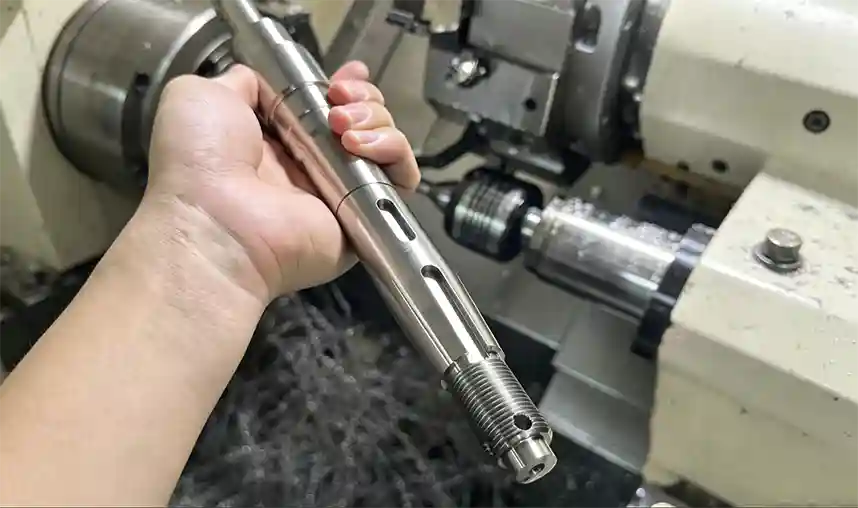
Precision Machining Processes
CNC Turning
Primarily used to machine rotational features such as outer diameters, steps, shoulders, and threads on shaft-type parts, ensuring dimensional accuracy between areas of different diameters.
CNC Milling
Used for precision milling of non-rotational features, such as long slots on shafts, to control the width, depth, and positional accuracy of the slots.
Spline Machining
Parts with distinct spline structures at their ends require precise machining of the spline profile and dimensions to ensure proper assembly and power transmission with mating parts.
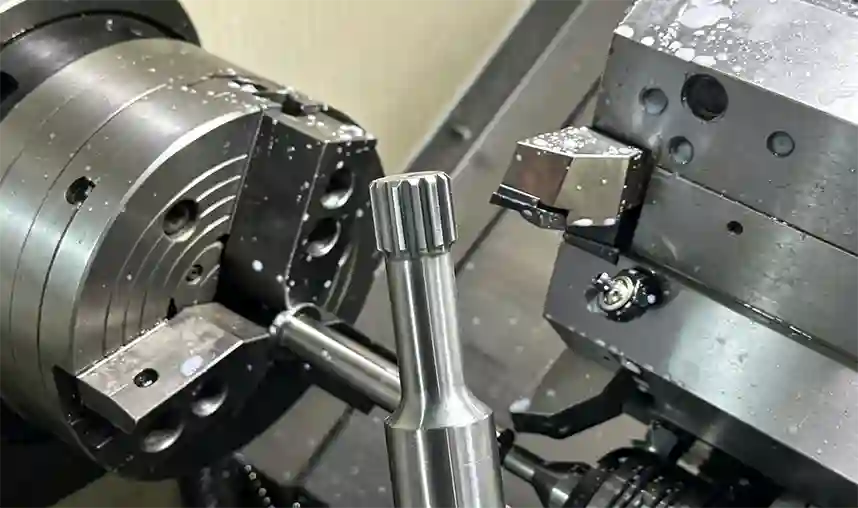
Quality Control
Throughout the entire machining process, XINXIU focuses on controlling the critical dimensions of the products and the positional relationships between their functional components.
The main inspection items include:
✓ Outer diameter and step dimensions
✓ Axial groove width and depth
✓ Thread dimensions
✓ Spline dimensions and tooth profile
✓ Coaxiality of each shaft section
✓ Positional accuracy of critical areas
✓ Surface finish quality
Through strict control of the machining and inspection processes, we ensure that parts meet customers’ dimensional and assembly requirements.
Advantages of XINXIU Turning-Milling Combination Machining
For complex shaft parts that involve turning, milling, threading, and spline features, combined turning and milling can effectively reduce the number of machining operations and re-clamping.