
Die-casting Mold Development, Aluminum Alloy Die-casting, CNC Finishing, and Leak Testing
The automotive steering gear is a critical component of the vehicle's steering system; its housing must not only possess good structural strength and dimensional stability but also meet requirements for precision assembly and airtightness.
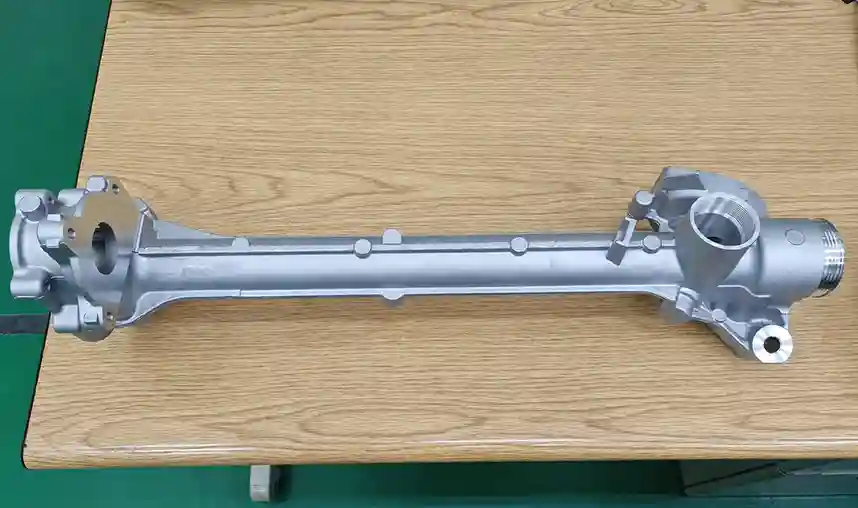
This aluminum alloy steering gear housing was custom-manufactured by XINXIU for a U.S. client. The product features a slender structure with different mounting and connection configurations at each end, as well as multiple holes, mounting surfaces, and complex local features. Given the product’s complex structure, the high difficulty of die-casting, and the stringent precision requirements for subsequent machining, XINXIU provides customers with a one-stop manufacturing service ranging from die-casting mold development, aluminum alloy die-casting, and CNC precision machining to airtightness testing.
Project Process: Die-casting Mold Development → Aluminum Alloy Die-casting → CNC Finishing → Airtightness Testing (X-ray Inspection + Leak Testing) → Final Product Inspection
Product Features: Aluminum alloy steering gear housing with a complex structure
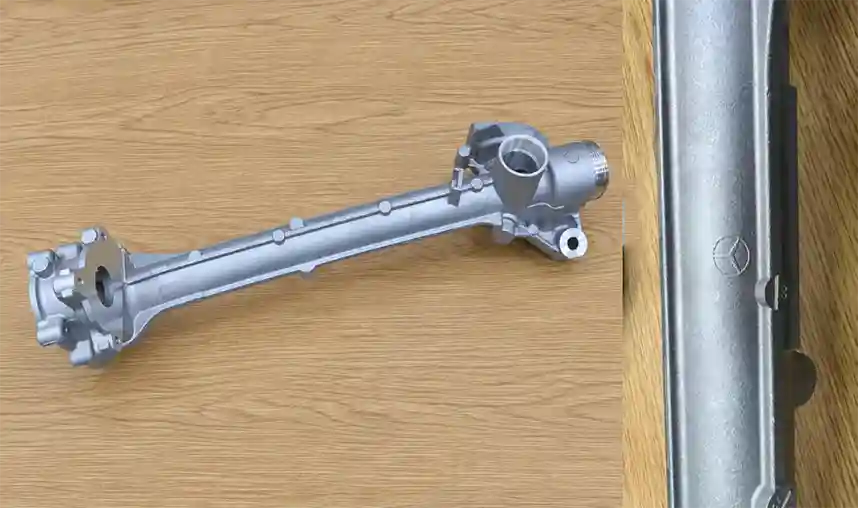
The steering gear housing is a relatively complex automotive aluminum alloy component. The product has an elongated structure, with different mounting and connection areas at each end, as well as multiple holes, mounting surfaces, and functional features distributed throughout.
The product must be formed consistently during the die-casting stage and provide adequate machining allowances and reliable machining reference points for subsequent CNC finishing.
For complex structural components, there are six sets of moving parts. Mold design must not only address issues such as parting lines, core pulling, and machining allowances, but also comprehensively consider multiple aspects of the die-casting process, including flash, gas entrapment, oxidation, cold shuts, and surface defects, as well as subsequent machining operations.
Die-Casting Mold Development
Optimizing Mold Design
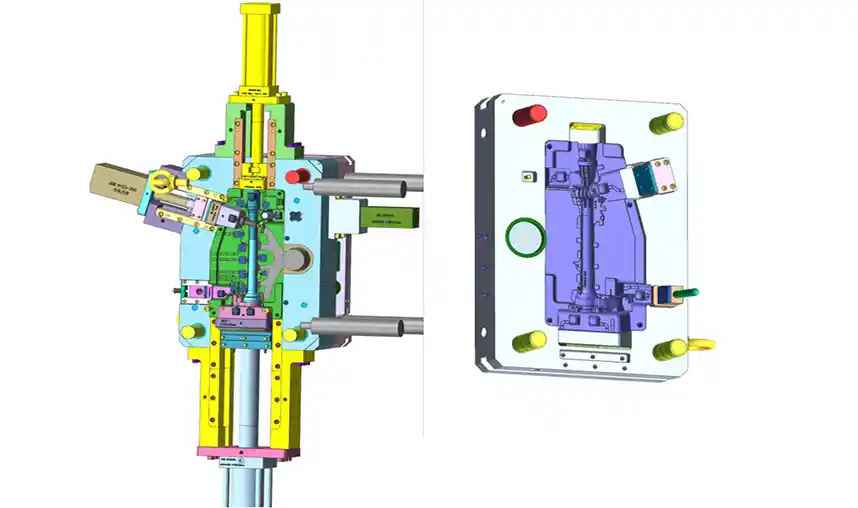
Given the complex structure of both ends and the sides of the steering gear housing, XINXIU developed a rational design for the mold parting line, sliders, and core-pulling mechanisms based on the product’s structure and die-casting requirements.
The product requires a maximum slide travel of approximately 370 mm, which is a relatively long stroke. To prevent the product from moving with the slide during mold opening, the mold design incorporates protruding stops on the core to limit its movement, keeping the product stable during the core-pulling process and ensuring smooth demolding.
At the same time, based on the product’s subsequent CNC machining requirements and our many years of experience in aluminum alloy die casting, we set appropriate machining allowances for areas requiring precision machining, while fully considering the internal porosity of the casting and the machining depth to prevent internal pores from being exposed due to excessive machining depth during subsequent processing.
Through comprehensive optimization of the positioning structure, product clearance, machining allowance, and mold strength, we ensure smooth demolding while improving product molding stability, thereby providing a reliable foundation for subsequent CNC machining and mass production.
Mold Flow Analysis
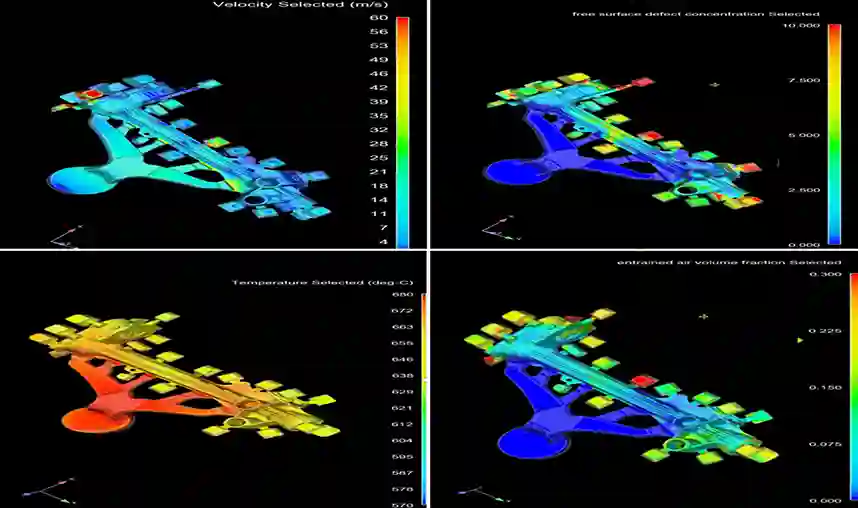
Given the slender structure and complex local geometries of the aluminum alloy steering gear housing, XINXIU conducted mold flow analysis during the die-casting mold development phase to simulate the product’s filling and solidification processes.
By analyzing the flow paths of molten aluminum within the cavity, the filling time, and the filling status in different areas, the team was able to anticipate potential issues such as entrapped air, trapped air, shrinkage cavities, and localized underfilling in advance, and adjust the gating system, overflow channels, and venting solutions accordingly.
After multiple rounds of simulation and adjustments to the feeding plan, the molten aluminum was able to flow more efficiently into all areas of the product, improving the filling condition in complex sections while reducing the risk of internal defects caused by improper flow. This provided a data foundation for subsequent mold design and die-casting production.
Aluminum Alloy Die Casting
One-Step Molding of Complex Structures
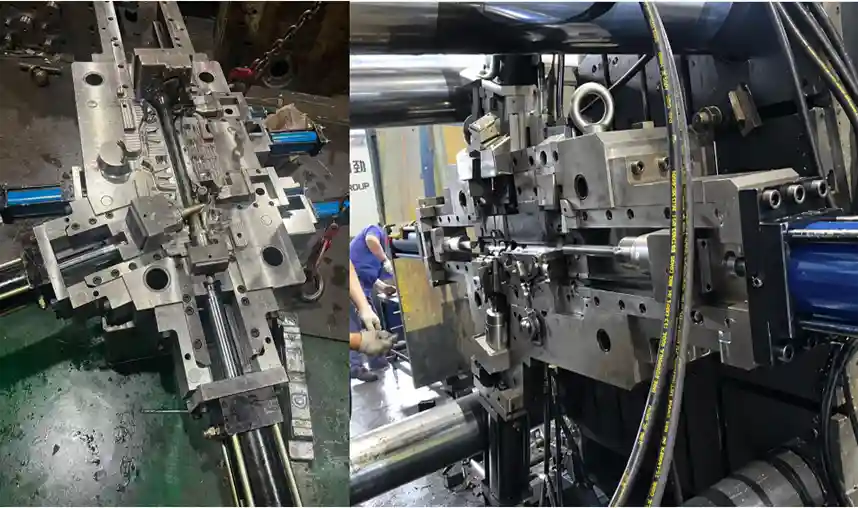
After the mold has been manufactured, assembled, and validated through trial casting, production of the aluminum alloy die-cast parts begins.
The molten aluminum alloy rapidly fills the mold cavities under high pressure, forming the steering gear housing casting. Due to the product’s elongated overall structure and complex local geometries, it is essential to closely control the filling, pressurization, venting, and solidification processes during production to minimize the risk of defects such as porosity, shrinkage cavities, and cold shuts.
To meet the product’s airtightness requirements, die-testing involves continuously adjusting die-casting parameters—particularly the pressure-building process—based on actual molding conditions. After each die-casting cycle, X-ray inspection is conducted promptly to check for internal defects such as porosity and shrinkage cavities, and die-casting parameters are continuously optimized based on the inspection results.
At the same time, given the structural characteristics of the product’s 370-mm-long slide, the trial molding process focuses on observing the slide’s core-pulling and retraction movements to check whether the long slide causes surface scratches or tears during motion. Based on the actual conditions, the slide clearance and motion parameters are adjusted accordingly.
During the die-casting production process, attention must also be paid to mold water cooling. The cooling status of each mold area must be properly controlled to prevent localized overheating or uneven cooling from affecting the stability of product formation.
CNC Precision Machining
Used in conjunction with specialized fixtures to meet critical dimensional and assembly requirements
After die casting is complete, the aluminum alloy steering gear housing enters the CNC precision machining process.
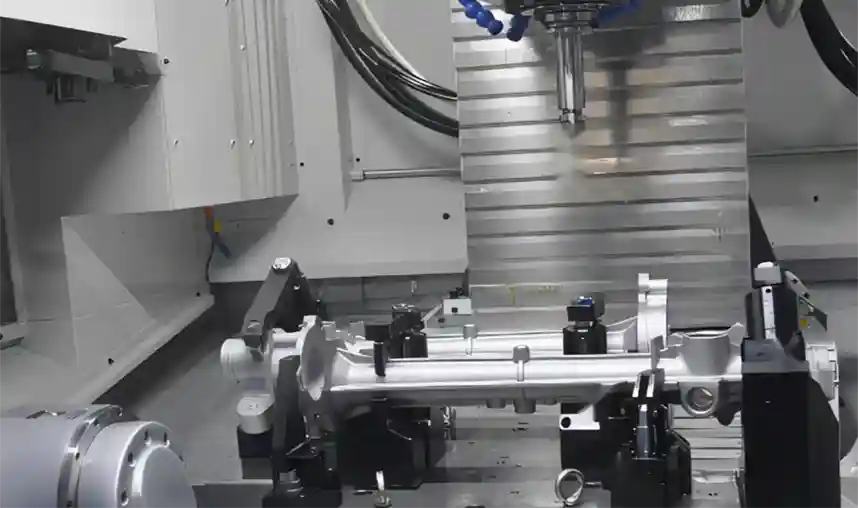
In accordance with product drawings and assembly requirements, precision machining is performed on mounting surfaces, hole positions, connection points, and other critical areas. Given the product’s relatively long overall length and complex structures at both ends, XINXIU designed and manufactured specialized CNC machining fixtures based on the product’s structure and machining processes. By appropriately setting positioning references and clamping methods, the stability of the product’s clamping was enhanced.
During machining, the fixture provides reliable positioning and support for the product, reducing vibration and deformation. By strategically planning machining reference points for multi-step processes and multiple setups, dimensional deviations caused by repeated positioning are minimized, ensuring the relative positional accuracy of critical dimensions, hole locations, and all assembly surfaces.
Leak Test
X-ray Inspection + Leak Testing
For aluminum alloy steering gear housings used in automotive steering systems, internal casting quality and sealing performance are critical aspects of product validation.
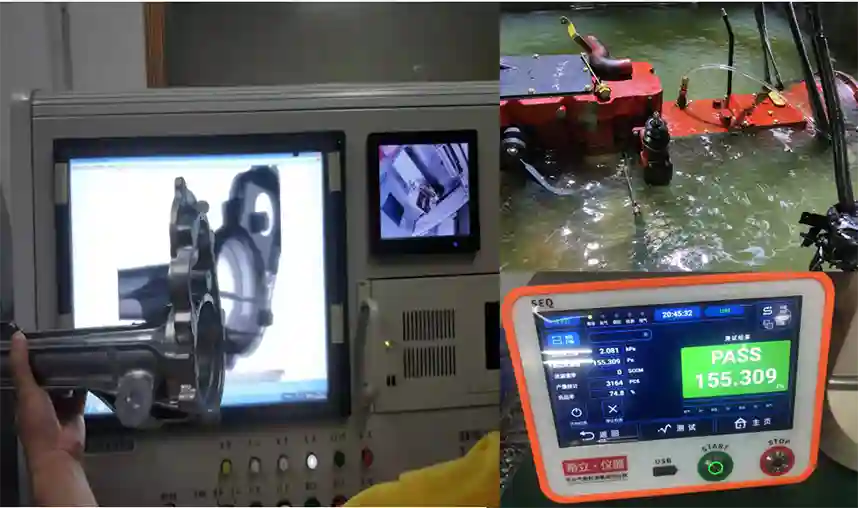
During die-casting trial runs and production, X-ray inspections are conducted immediately after each part is cast, focusing on defects such as porosity and shrinkage cavities inside the castings. Based on the X-ray inspection results, adjustments are continuously made to the pressure parameters, filling conditions, and mold cooling during the die-casting process to ensure consistent internal quality of the products.
After CNC finishing is complete, the products undergo leak testing to verify their actual sealing performance and detect any leaks. By combining X-ray inspection with leak testing, product quality is controlled from both the perspectives of internal casting quality and actual sealing performance.
Specifically, X-ray inspection is primarily used to detect potential internal defects, while leak testing is used to confirm the product’s actual sealing performance. These two methods work in tandem to provide reliable assurance for the subsequent assembly and use of automotive steering systems.
Final Inspection
Final Quality Verification Following Multiple Process Steps
After completing aluminum alloy die casting, CNC precision machining, and airtightness testing, the steering gear housing undergoes a final inspection.
Based on customer drawings and technical requirements, a comprehensive verification of the product’s appearance, critical dimensions, machined areas, hole locations, and airtightness test results is conducted to ensure the product meets subsequent assembly requirements.
Through end-to-end quality control—from die-casting and CNC machining to final inspection—we enhance dimensional consistency and machining stability, providing reliable aluminum alloy die-cast products for automotive steering system components.
One-Stop Aluminum Alloy Die-Casting Manufacturing
This project covers multiple stages, including die-casting mold development, mold manufacturing and trial casting, aluminum alloy die-casting, CNC precision machining, airtightness testing, and finished product inspection.
Complete Process Flow:
Product Structural Analysis→Die-Casting Mold Development→Mold Manufacturing, Assembly, and Trial Runs→Aluminum Alloy Die-Casting→X-Ray Inspection and Die-Casting Process Adjustments→Deburring and Post-Processing→CNC Precision Machining→Air Tightness Testing (Leak Testing)→Final Product Inspection
Starting with the initial mold development phase, XINXIU takes a comprehensive approach to product forming, linear motion structures, machining allowances, CNC fixtures, and subsequent inspection requirements, creating a seamless manufacturing process that integrates all production steps and provides one-stop manufacturing services for complex aluminum alloy automotive components.
XINXIU New Talent Automotive Aluminum Alloy Die Casting
Aluminum Alloy Die Casting | Die Casting Mold Development | Steering Gear Housings | CNC Finishing | Custom Fixtures | X-ray Inspection | Leak Testing | Automotive Parts
From mold development to die-casting, and on to CNC finishing and quality inspection, XINXIU provides automotive industry clients with one-stop manufacturing services for complex aluminum alloy structural components.