nternal Link Plan
Article
Single-Cavity vs Multi-Cavity Die Casting Molds: How to Choose for Production
Introduction
Cavity count is a production-strategy decision. A single-cavity die casting mold makes one part per cycle, while a multi-cavity mold produces multiple parts during the same machine cycle. More cavities can increase output, but they also add tooling complexity and may require a different machine or process balance.
The right question is not “Which mold is cheaper?” It is “Which cavity strategy produces the required volume with an acceptable combination of throughput, quality, tooling investment and maintenance?”
1. What Is a Single-Cavity Mold?
A single-cavity mold produces one casting per cycle. It can be attractive when annual demand is uncertain, the part is large, the tool must remain relatively simple, or the development program is still changing.
The main advantage is straightforward validation and process control. There are fewer cavity-to-cavity variables and fewer duplicated inserts to maintain.
2. What Is a Multi-Cavity Mold?
A multi-cavity mold produces two or more parts per cycle. Common configurations can include two, four or more cavities depending on part size, machine capacity and production requirements.
The main economic advantage is higher output per cycle. However, the runner, gate, cooling and ejection systems must support all cavities consistently.
3. The First Decision: Forecast Volume
Cavity count should start with demand rather than with the mold shop’s preferred configuration.
Ask:
- How many parts are required per year?
- How stable is the forecast?
- How many production hours are available?
- Is demand seasonal?
- Will the product remain unchanged long enough to justify more complex tooling?
A high-volume program with stable geometry is more likely to justify multi-cavity tooling.
4. Machine Capacity Can Limit Cavity Count
Adding cavities increases projected casting area, shot volume and total metal handled per cycle. The tool must fit the selected machine in terms of clamping force, shot capacity, die dimensions and automation.
A theoretical four-cavity tool may look attractive until the required machine is significantly larger or less available. In that situation, a simpler two-cavity or single-cavity strategy may be more practical.
5. Output Is More Than “Parts Per Cycle”
A simple output model is:
Hourly output ≈ parts per cycle × 3600 ÷ cycle time × good-part yield.
For example, a four-cavity tool does not automatically produce four times the sellable output of a single-cavity tool if cycle time, scrap, maintenance or machine constraints change.
This is why cavity decisions should be based on good parts per hour rather than cavity count alone.
6. Tooling Complexity
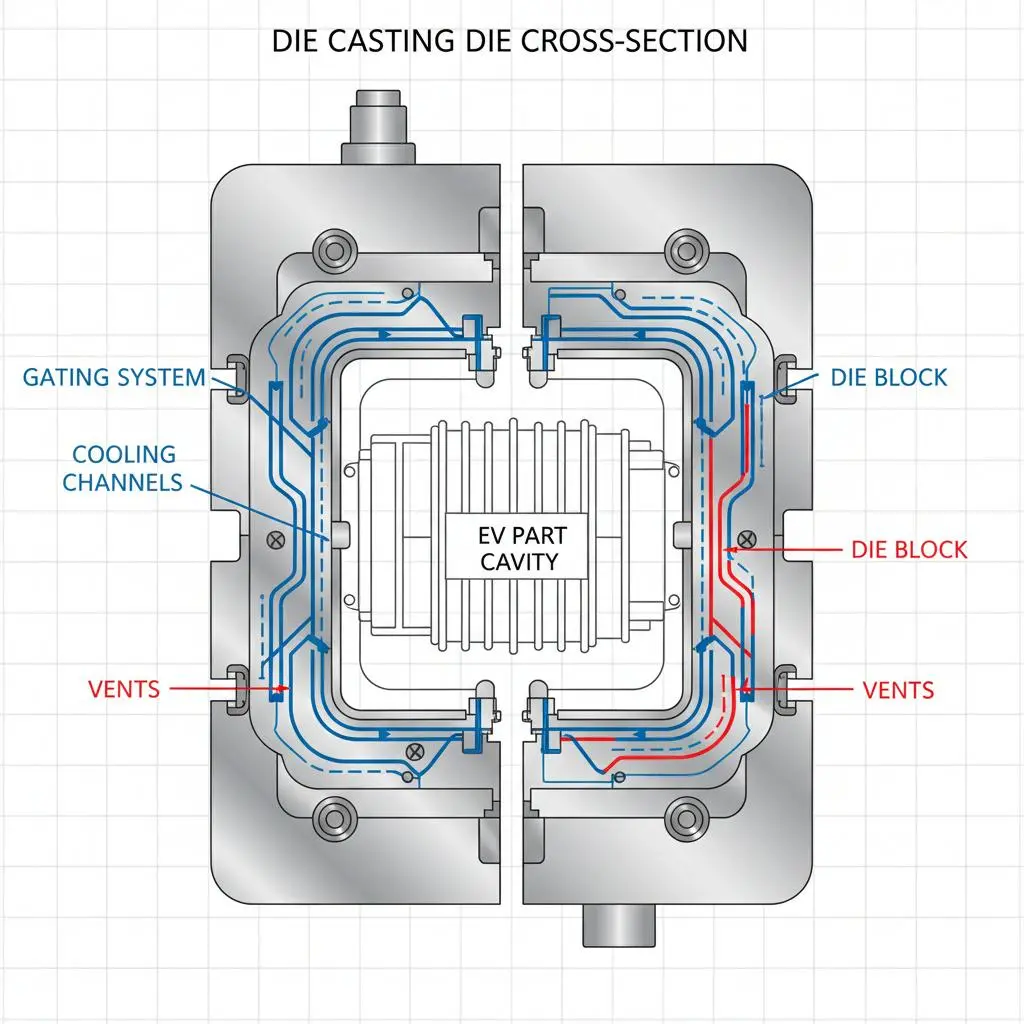
Multi-cavity tooling usually needs more cavity inserts and a more carefully balanced runner and gate system. Cooling and ejection must also operate consistently across cavities.
The additional engineering effort can be justified when volume is high enough to use the increased output. It can be wasteful when demand is low or uncertain.
7. Quality and Cavity Balance
Each cavity should produce parts within the required process window. Differences in filling, cooling or pressure behavior can cause cavity-to-cavity variation.
Quality planning may therefore need:
- cavity identification
- first-article checks for each cavity
- periodic dimensional verification
- cavity-specific traceability where needed
- inspection after major tool maintenance.
8. Maintenance Considerations
A single-cavity tool has fewer duplicated components. A multi-cavity tool can have more inserts, gates, cooling paths and wear locations.
If one cavity requires maintenance, the production strategy should define whether the entire tool stops or whether the issue can be isolated. Serviceable inserts and accessible components become more valuable as cavity count rises.
9. Break-Even Thinking
Suppose a single-cavity tool costs $20,000 and a four-cavity tool costs $35,000. The multi-cavity tool has $15,000 of additional upfront investment.
If the four-cavity design lowers recurring cost enough through higher output, the additional tooling investment can eventually be recovered. If annual demand is low, the recovery may never happen.
The break-even calculation should include:
- tool cost difference
- machine hourly rate
- cycle time
- good-part yield
- runner and material consumption
- maintenance
- downstream machining
- expected annual volume.
10. When Single-Cavity Is Usually Attractive
Single-cavity tooling can make sense for:
- large housings
- uncertain demand
- frequent design revisions
- low-volume programs
- products that already consume significant machine capacity
- development stages where validation simplicity matters.
11. When Multi-Cavity Is Usually Attractive
Multi-cavity tooling is more attractive when:
- demand is high and stable
- the part is small or medium-sized
- the design is mature
- machine capacity is available
- higher throughput is commercially valuable
- recurring unit economics justify the larger tooling investment.
12. Can Different Parts Share a Tool?
Some product families may create opportunities for family or interchangeable tooling, but compatibility must be evaluated carefully. Alloy, size, geometry, demand and filling behavior all matter.
A shared-tool concept should not be used simply to reduce the initial quote if it creates difficult balancing, maintenance or quality problems.
13. Example: Large Aluminum Housing
A large aluminum housing may already use a substantial portion of machine capacity. Adding cavities could force a move to a larger machine, increase shot size and make the mold harder to balance.
A smaller bracket with stable annual demand can have the opposite economics. Producing several pieces per cycle may reduce machine time per part enough to justify a more complex tool.
14. How to Decide Before Mold Design
Give the mold supplier:
- annual and order quantity
- part dimensions and weight
- alloy
- expected program life
- target cycle time, if known
- required quality level
- downstream machining requirements.
The supplier can then compare cavity options using real machine and process assumptions.
Conclusion
Single-cavity and multi-cavity molds solve different production problems. Single-cavity tooling favors simplicity, flexibility and lower initial complexity. Multi-cavity tooling favors throughput and lower recurring cost when volume is sufficient. The best choice should be based on good parts per hour, total tooling investment, machine capacity, quality requirements and expected program volume rather than cavity count alone.
FAQ: Is a multi-cavity die casting mold always cheaper per part?
No. It can lower recurring cost at sufficient volume, but the higher tooling investment, machine requirements and maintenance must be considered.
FAQ: How many cavities should a die casting mold have?
There is no universal answer. The decision depends on annual volume, part size, machine capacity, cycle time, quality requirements and program life.
FAQ: Is single-cavity tooling better for prototypes?
It is often easier to validate and maintain, especially when demand is uncertain or the design may change.
FAQ: What is the main risk of multi-cavity tooling?
Cavity-to-cavity imbalance can create differences in filling, cooling or quality. The mold must be designed and validated as a balanced production system.
FAQ: Can a large part use a multi-cavity mold?
Sometimes, but the machine and mold dimensions may make additional cavities impractical. Machine capacity should be checked before the cavity strategy is finalized.