
Process: CNC aluminum milling / CNC precision machining
Material: 6061 aluminum alloy
Product: Aluminum alloy lighting fixture prototype
Client: Italian client
Project Objective: To validate the product design prior to die-casting mold production
For aluminum alloy lighting products, structural and aesthetic validation must be completed between the finalization of the design and the start of mass production.If a product proceeds directly to die-casting mold development, any subsequent issues with structure, dimensions, or assembly may require mold modifications, which not only increase development costs but also impact the project schedule.Therefore, prior to formally proceeding with die-casting mold development, this Italian client chose to first produce a set of 6061 aluminum alloy CNC prototypes to validate the product design using actual metal samples.Through these CNC prototypes, the client can confirm the product’s overall appearance, structural dimensions, mounting locations, and actual assembly results in advance, enabling them to identify and address design issues in a timely manner before mold production begins.
From Manufacturing to Final Product Evaluation
The XinXiu CNC team conducted a process analysis based on the 3D drawings provided by the customer:
This lamp prototype is relatively large in overall size and features a complex internal structure with numerous details, which places certain demands on machining precision and toolpath planning. During the machining process, precise control is required over the product’s outer contours, internal structure, mounting holes, and various details.
By CNC milling aluminum, the aluminum alloy material can be directly machined into a physical prototype that closely resembles the final product, allowing the client to evaluate the design from the perspective of an actual product.
Compared to confirmation based solely on 3D models, aluminum alloy CNC prototypes provide more intuitive verification in terms of dimensions, structure, assembly, and appearance.
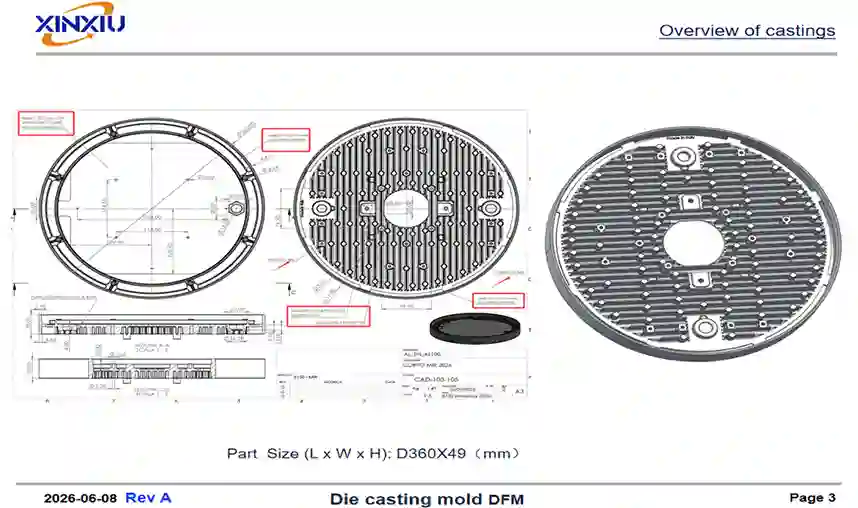
Verify the design with physical prototypes to reduce the risks associated with die-casting mold production
The primary purpose of this CNC prototype fabrication is not for direct use in mass production, but rather to validate the design prior to the subsequent die-casting mold fabrication.
After receiving the prototype, the customer can physically inspect and assemble the product, focusing on confirming the following:
1. Do the product’s overall dimensions and appearance meet the design requirements?
2. Is the internal structure reasonable?
3. Are the mounting hole positions accurate?
4. Does the product assemble smoothly with other components?
5. Does the product’s overall visual appearance meet expectations?
6. Is the design suitable for subsequent die-casting production?
If areas requiring optimization are identified at this stage, the 3D data can be modified first before proceeding to die-casting mold development, thereby preventing design issues from carrying over into the mold-making phase.
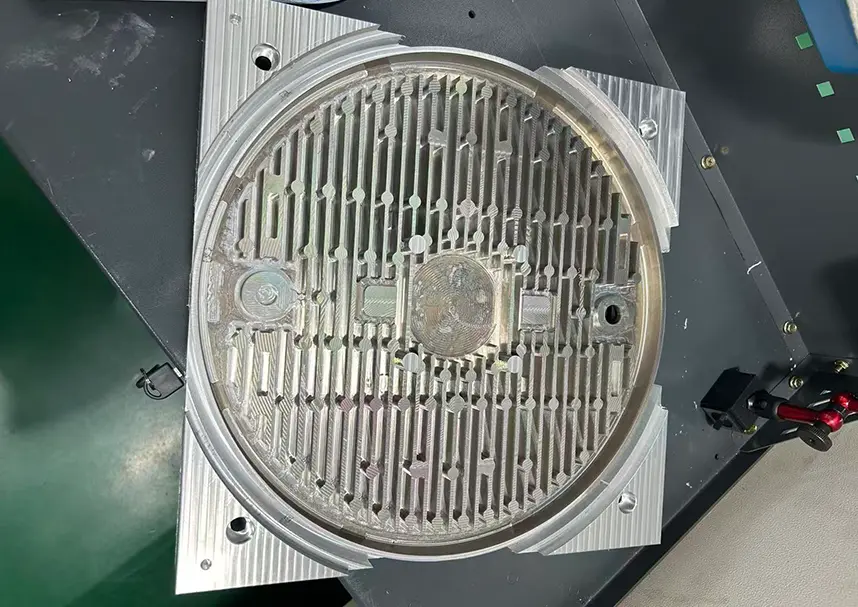
After the CNC prototype has been validated, proceed to die casting mold making.
For aluminum alloy products with complex structures, such as lighting fixtures, CNC prototype validation is a crucial step before creating a die-casting mold.
This project uses CNC machining of 6061 aluminum alloy to quickly transform the customer’s 3D design into a physical prototype. After physical inspection and assembly verification, the project proceeds to the next phase of die-casting mold development based on the final approved design.
The development process of “CNC prototype validation → design optimization → die-casting mold development → mass production” helps customers identify issues early on, reduces the need for mold modifications, and lowers overall development risks.
Based on customers’ 3D/2D drawings, XinXiu offers CNC milling services for aluminum and aluminum alloy prototypes and product mockups, helping customers validate their product designs before formal tooling and preparing them for subsequent die-casting mass production.
First, validate the design using CNC prototypes, then proceed with die-casting mold fabrication to ensure a more reliable and efficient product development process.