
Project Overview
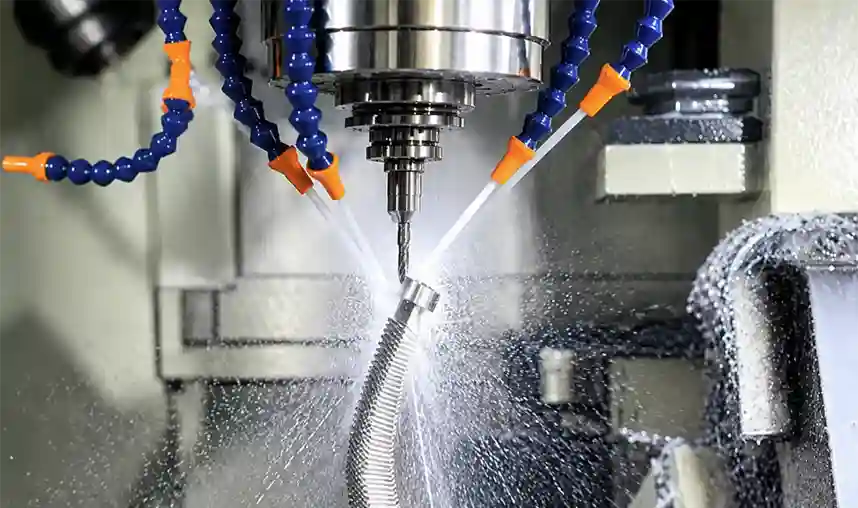
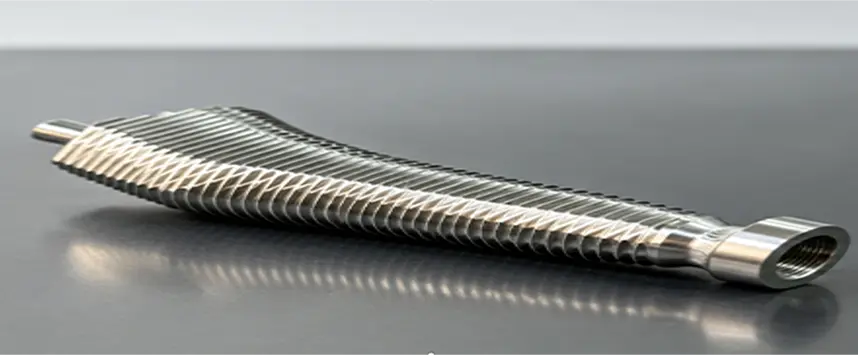
Precision CNC machining of medical-grade stainless steel femoral prostheses, which are high-precision medical device components used in orthopedic implants. The product features a slender, conical structure with a dense pattern of interlacing serrations distributed across its surface, combined with a biomimetic curved articular surface and a precision assembly opening on the back. It has a complex structure and requires extremely high precision.
We completed prototype manufacturing for an Australian client using medical-grade stainless steel. The parts were subject to stringent requirements regarding tooth pattern consistency, surface finish, contour accuracy, and medical implant safety standards, and ultimately had to meet the assembly and performance validation standards for the prototype.
Challenge
1. Risk of deformation in slender cantilever structures: The workpiece is clamped only at the bottom connection base, while the upper section forms a long cantilever structure. The cutting forces can easily cause vibration, leading to distortion of the tooth profile and the spherical joint surface, which directly affects the assembly accuracy of the prosthesis.
2. Complex multi-feature toolpaths: Interlaced tooth patterns around the circumference, high-precision spherical joint surfaces, and a rear opening are integrated into a single part, requiring five-axis simultaneous machining with multi-angle oscillating cuts. This poses a high risk of tool interference and entails a significant workload for CAM programming and simulation verification.
3. Controlling ultra-high surface and contour specifications is highly challenging: The joint mating surface requires Ra < 0.8 μm, the joint surface contour tolerance must be ≤0.08 mm, and the dimensional tolerance of the rear mounting opening must be consistently controlled within ±0.02 mm. Medical-grade stainless steel exhibits a pronounced tendency for tool sticking, placing extremely high demands on tool selection, cutting parameters, and finishing strategies.
4. Difficulty in controlling tooth profile consistency: The parts feature a large number of fine tooth patterns; the depth and spacing of the tooth profiles must be uniform and consistent, and chipping or burrs are strictly prohibited to meet medical device surface specifications.
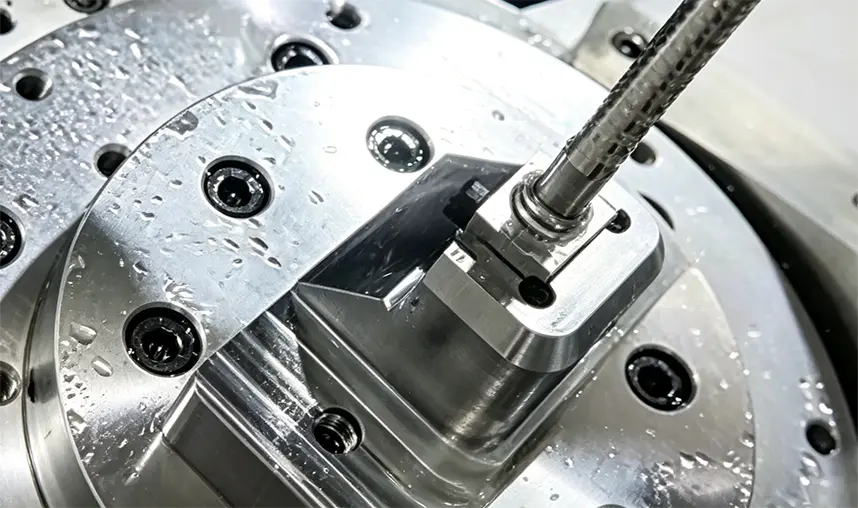
5. Restricted clamping reference conditions: Clamping is limited to the bottom flange base; the joint mating surfaces, external surfaces, and assembly mating areas must not be damaged, requiring custom-made jigs and fixtures.
6. High comprehensive requirements for medical-grade products: Finished products must be free of scratches and microcracks; chip residue in the tooth gaps and cavity interiors must be thoroughly removed to ensure safety during implantation.
XinXiu Precision Machining Processes
Five-Axis Rotary Table Single-End Clamping MachiningA custom-designed fixture is used to clamp the workpiece’s bottom flange base. With a single setup, combined with five-axis simultaneous swivel motion, the process completes the machining of all features—including circumferential gear teeth, spherical joint surfaces, and rear openings—thereby reducing cumulative positioning errors caused by multiple setups.
Comprehensive Machining SimulationFull toolpath simulation and verification are performed prior to machining to identify tool interference in advance. Given the difficult-to-machine characteristics of medical-grade stainless steel, layered cutting, feed rate, and spindle speed parameters are optimized to suppress chattering during the machining of slender parts and minimize vibration marks and deformation defects.
Tiered Finishing and Medical-Grade Post-ProcessingA step-by-step process of roughing → semi-finishing → multi-pass finishing is adopted to consistently ensure compliance with surface roughness and contour accuracy requirements for joint surfaces. After machining, precision deburring and cleaning are performed to thoroughly remove chip residue from tooth gaps and internal cavities while protecting the tooth profiles and spherical features.
Multi-dimensional Full-Dimensional Inspection and VerificationKey parameters—such as joint surface contour, rear opening dimensions, and tooth profile—are inspected using a coordinate measuring machine (CMM); Ra values are verified with a surface roughness meter; and surface microcracks and burr defects are screened using a microscope. A comprehensive inspection report is generated to meet medical prototype validation requirements.
Project Deliverables
The finished intermeshing gear profiles are complete and uniform, with no chipped edges, no vibration marks, and no tool marks; the surface roughness of the joint surfaces is Ra < 0.8 μm, the profile accuracy is ≤ 0.08 mm, and the dimensions of the rear openings are consistently maintained within a tolerance range of ±0.02 mm; all critical dimensions and geometric tolerances comply with the drawing specifications.
The parts require no secondary finishing and can be used directly for prosthesis assembly and performance validation. The complete manufacturing process supports both medical prototype production and stable delivery of small- to medium-volume batches.
XINXIU's Scope of Machining Services:
XinXiu Precision specializes in 5-axis CNC machining of slender, irregularly shaped, and complex-surfaced medical implants.We undertake projects involving artificial bone joints, orthopedic implants, precision thermal components, irregularly shaped fluid components, and precision test prototypes;We machine difficult-to-machine medical materials such as medical-grade stainless steel, titanium alloys, and cobalt-chromium alloys, and provide one-stop services including DFM process reviews, precision CNC machining, and dimensional inspection.