CNC Tolerance Guide: What Tolerances Really Mean in Manufacturing
In CNC machining, tolerance is one of the most misunderstood yet most important engineering parameters. It directly defines how much deviation is acceptable between the designed dimension and the final manufactured part.
Many CNC projects experience unexpected cost increases not because of material or machining method, but because tolerances are overly strict or incorrectly specified.
At Xinxiu Precision Technology, we review hundreds of CNC designs every year. One of the most common issues we observe is that engineers apply tight tolerances across all features—even when only a few functional surfaces actually require high precision.
This guide explains what CNC tolerances really mean, how they affect manufacturing cost, and how engineers can apply them correctly to improve both quality and cost efficiency.
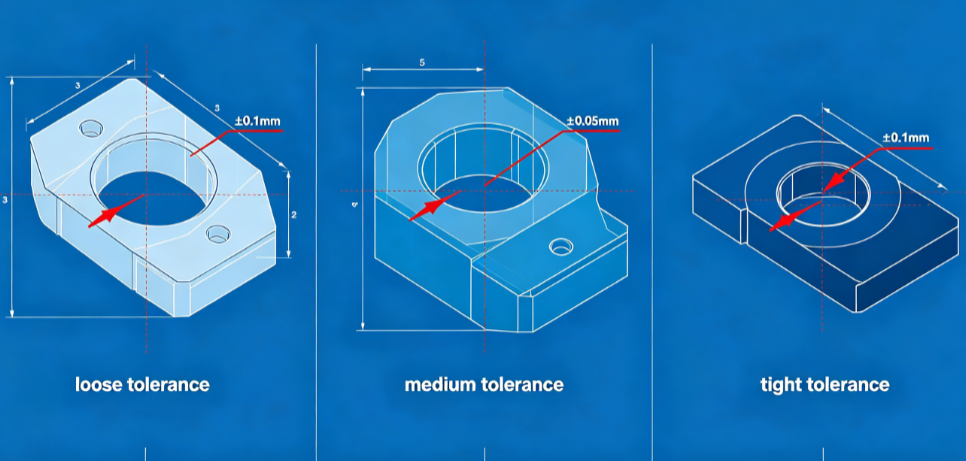
CNC Tolerance Quick Reference Guide
| Tolerance Type | Typical Range | Manufacturing Impact |
|---|---|---|
| General CNC Tolerance | ±0.1 mm | Standard cost |
| Medium Precision | ±0.05 mm | Moderate cost increase |
| High Precision | ±0.01 mm | High cost increase |
| Ultra Precision | ±0.005 mm or tighter | Significant cost increase |
Engineer’s Rule of Thumb:
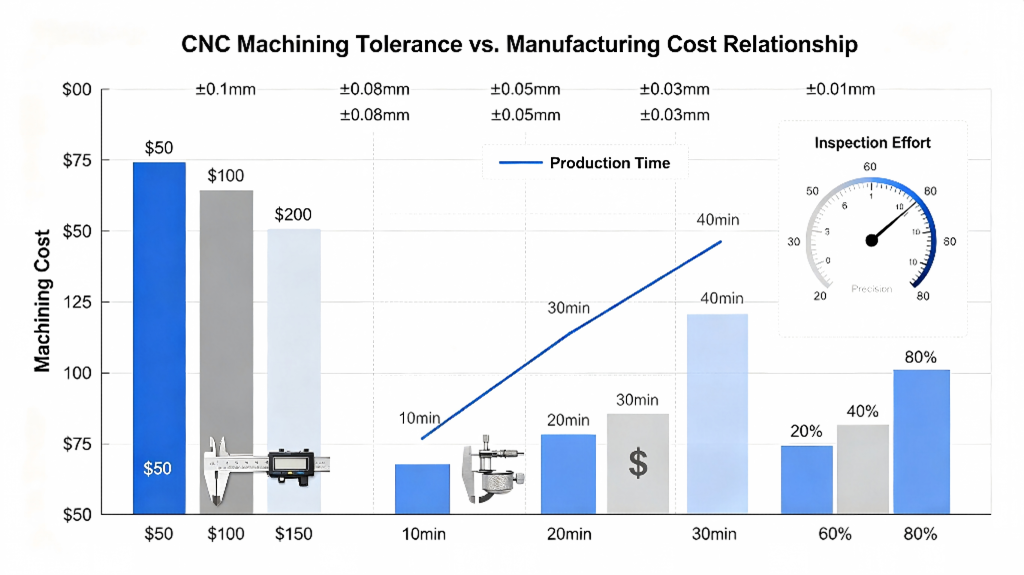
The tighter the tolerance, the higher the machining cost due to slower cutting speeds, additional inspection, and increased scrap risk.
What Does CNC Tolerance Really Mean?
CNC tolerance defines the allowable deviation from a nominal dimension.
For example:
If a part is designed as 10.00 mm ±0.10 mm, the acceptable range is:
- Minimum: 9.90 mm
- Maximum: 10.10 mm
This means any part within this range is considered acceptable.
However, in real manufacturing, achieving tighter tolerances requires:
- Slower machining speeds
- More precise tooling
- Additional machine calibration
- Increased inspection time
- Higher rejection rates
All of these factors directly increase cost.
Why Tight Tolerances Increase CNC Cost
Tolerances are one of the most significant cost drivers in CNC machining.
1. Slower Machining Speed
Tighter tolerances require reduced feed rates to maintain dimensional accuracy. This increases machine time per part.
2. Tool Wear and Replacement
High-precision machining increases tool wear, requiring more frequent tool changes and calibration.
3. Additional Inspection Requirements
Parts with tight tolerances often require:
- CMM inspection (Coordinate Measuring Machine)
- Manual gauge measurement
- Quality verification reports
This increases both labor and production time.
4. Higher Scrap Rate
As tolerances become tighter, the probability of parts falling outside acceptable range increases, resulting in material waste.
Standard CNC Tolerances vs Precision Tolerances
Most CNC machining applications do NOT require ultra-tight tolerances.
| Feature Type | Recommended Tolerance |
|---|---|
| Non-functional surfaces | ±0.1 mm |
| General assembly features | ±0.05 mm |
| Mating parts | ±0.02 mm |
| Bearing / sealing surfaces | ±0.01 mm |
Xinxiu Engineering Insight:
Over 70% of CNC cost overruns come from unnecessary tight tolerances applied to non-functional features.
How to Apply Tolerances Correctly (DFM Approach)
Design for Manufacturability (DFM) plays a critical role in optimizing tolerances.
1. Define Functional Features First
Only apply tight tolerances to:
- Mating surfaces
- Bearing fits
- Sealing interfaces
- Alignment holes
2. Use General Tolerances Elsewhere
Non-critical features should use standard tolerances such as ±0.1 mm.
3. Avoid Over-Specification
Avoid applying:
- ±0.01 mm everywhere
- Tight tolerances on cosmetic surfaces
- Uniform tolerance across entire part
4. Communicate with Manufacturer Early
Early engineering review helps identify unnecessary tolerance constraints before production begins.
At Xinxiu Precision Technology, our engineers review CAD files before machining to ensure tolerances are optimized for both function and cost efficiency.
Common CNC Tolerance Mistakes
❌ Mistake 1: Over-Tolerancing Entire Part
This significantly increases machining time without improving performance.
❌ Mistake 2: Ignoring Stack-Up Effects
Multiple tight tolerances in assembly can create cumulative deviation issues.
❌ Mistake 3: Not Considering Manufacturing Method
Different processes have different achievable tolerances:
- CNC milling: high precision
- casting: moderate precision
- 3D printing: lower precision
When Tight Tolerances ARE Necessary
Not all tolerances should be relaxed.
Tight tolerances are essential for:
- Precision assemblies
- Bearing fits
- Fluid sealing components
- High-speed rotating parts
- Medical or aerospace applications
How Xinxiu Precision Technology Supports Tolerance Optimization
At Xinxiu Precision Technology, we help customers optimize tolerances before production.
Our engineering team:
- Reviews CAD drawings for manufacturability
- Identifies over-specified tolerances
- Suggests cost-effective tolerance adjustments
- Ensures functional requirements are maintained
- Reduces unnecessary machining time
This process often reduces CNC machining cost while maintaining full part functionality.
Conclusion
CNC tolerance is not just a design specification—it is a direct cost driver in manufacturing.
Applying unnecessarily tight tolerances across all features can significantly increase machining time, inspection effort, and overall production cost.
By applying Design for Manufacturability (DFM) principles and understanding which features truly require precision, engineers can dramatically reduce cost while maintaining product performance.