Introduction
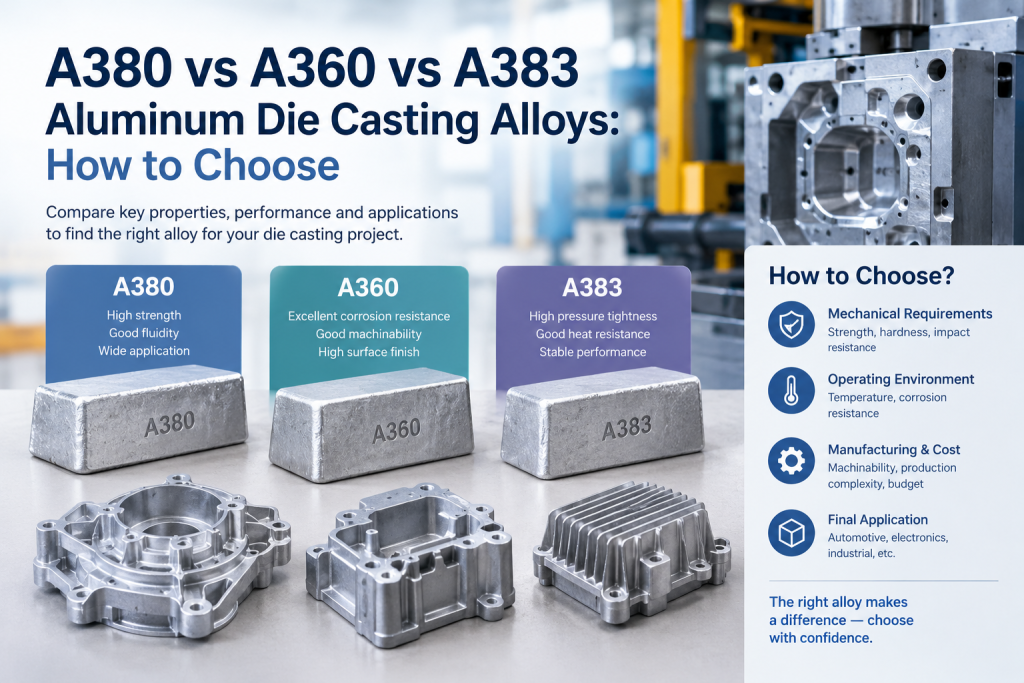
Choosing an aluminum die-casting alloy is a trade-off among casting behavior, mechanical requirements, corrosion exposure, pressure tightness, finishing, and cost. A380, A360, and A383 are common options in many high-pressure die-casting discussions, but none is automatically best for every part. Final selection should be confirmed against the required specification, actual supplier capability, and the component’s service environment.
A380: a common general-purpose option
A380 is widely used because it offers a practical balance of castability, strength, and production economics for many complex parts. It is often considered for housings, brackets, covers, and general industrial components. However, a familiar alloy name is not a substitute for reviewing the required mechanical properties, wall sections, machining locations, coating requirements, and operating conditions.
A360: when corrosion and pressure-related considerations matter
A360 is often considered where corrosion resistance and pressure-tightness-related performance are important design considerations. These benefits must still be validated for the actual casting geometry and process. Thin walls, complex flow paths, local hot spots, and machining through critical walls can affect results, so alloy selection should be paired with a realistic process and inspection plan.
A383: for complex geometry and filling challenges
A383 may be evaluated for parts with intricate features or demanding filling conditions. Its suitability depends on the geometry, section thickness, required properties, and production process. Do not assume that an alloy selected for castability will automatically satisfy every strength, corrosion, or finishing requirement.
Comparison framework
Compare candidate alloys across: (1) required strength and elongation; (2) corrosion exposure; (3) wall thickness and geometry; (4) pressure or leak-tightness requirements; (5) machining allowance and exposed machined surfaces; (6) coating or finishing process; (7) applicable material specification and test method; and (8) production consistency. Use current material standards and supplier-confirmed data rather than generic online tables as the final authority.
Questions to answer before approving an alloy
What loads will the part carry? Will it contact water, salt, chemicals, or elevated temperatures? Does it need to retain pressure? Which surfaces will be machined? Is the component painted, powder-coated, anodized, or left as-cast? What documentation is required? These answers can change the ranking of candidate alloys.
For related manufacturing guidance and project support, explore our die-casting services, Die Casting Guide, and die-casting case studies.
Conclusion
A380, A360, and A383 each have potential uses, but alloy choice should be driven by part function and validation requirements. Ask the die-casting supplier to review the drawing, critical areas, finishing route, and inspection plan before locking the material into the specification.
FAQs
Is A380 always the lowest-cost option?** Not necessarily; total cost depends on yield, process stability, finishing, inspection, and performance requirements.
Can alloy names be used without a standard?** The drawing or purchase order should identify the applicable specification and required documentation.
Should alloy selection happen before tooling? Yes. Material affects process planning and should be agreed before tooling design is finalized.