
📌 Engineering Summary – Key Takeaways
- Mold design determines the quality limit – process optimization can reduce defects, but mold design sets the achievable quality ceiling. Most recurring defects originate from poor runner, gate, venting, or cooling design.
- 8+ common defects covered: gas porosity, shrinkage porosity, cold shuts, misruns, flash, cracks, die soldering, and dimensional variation – each with root causes, solutions, and prevention strategies.
- Porosity has two distinct types: gas porosity (trapped air, smooth round pores) and shrinkage porosity (solidification contraction, irregular cavities) – requiring different solutions.
- Mold design systems: runner design controls flow direction; gate design controls filling speed and turbulence; overflow captures impurities; venting removes air; cooling controls solidification; vacuum improves internal quality.
- Process parameters matter: injection speed, pressure, metal temperature, die temperature, and cooling time all influence defect formation – the goal is a stable process window, not a single perfect parameter.
- Advanced inspection: X-ray, CT scanning, CMM, leak testing, and mechanical testing verify internal and dimensional quality – visual inspection alone is insufficient for critical castings.
Bottom line: The best defect prevention strategy is designing quality into the mold before production begins. A well-designed die casting mold controls metal flow, air evacuation, heat removal, and solidification – preventing defects rather than correcting them after they appear.
1. Why Do Die Casting Defects Happen and Why Does Mold Design Matter?
Many people assume that die-casting defects are mainly caused by incorrect machine settings. A common explanation in production is that the casting problem can be solved by adjusting injection speed, pressure, or temperature. Although process parameters are important, this explanation is incomplete.
In real manufacturing environments, die casting quality is controlled by a combination of multiple engineering systems:
| Control Factor | Main Influence on Casting Quality |
|---|---|
| Die casting mold design | Determines metal flow, filling balance, venting efficiency, cooling behavior, and solidification quality |
| Material quality | Affects alloy performance, gas content, oxide formation, and mechanical properties |
| Process parameters | Controls injection speed, pressure, temperature, and cycle stability |
| Production control | Ensures equipment stability, maintenance quality, and process repeatability |
Key engineering insight: Process optimization can reduce defects, but mold design determines the achievable quality limit of a die casting part. A poorly designed mold can often be adjusted to produce acceptable samples. However, during mass production, problems such as porosity increase, short filling, flash, cracks, and dimensional variation may repeatedly appear because the fundamental issue exists in the mold structure.
1.1 Why Are Die Casting Defects More Than Machine Parameter Problems?
High-pressure die casting is a highly dynamic manufacturing process. Unlike slower metal forming methods, molten aluminum is injected into a steel mold cavity at extremely high speed under significant pressure. During this short filling stage, multiple physical events occur simultaneously: liquid metal flow, air displacement, heat transfer, solidification, shrinkage formation, and stress development.
A small mistake in mold design can influence the entire casting process. For example: a poor gate design may create turbulent metal flow → increased air entrapment → internal porosity → reduced mechanical strength. A poor cooling layout may cause uneven solidification → hot spots → shrinkage defects → dimensional instability.
1.2 Why Is Aluminum Die Casting Particularly Challenging?
Aluminum die casting is widely used because aluminum alloys provide lightweight properties, good strength-to-weight ratio, corrosion resistance, excellent recyclability, and good dimensional stability. However, aluminum alloys also create several manufacturing challenges. High-speed filling creates flow control challenges – fast filling enables thin walls and high productivity, but also increases risks of turbulent flow, air entrapment, and flow imbalance.
1.3 Why Can Two Suppliers Produce Completely Different Die Casting Quality?
A common situation in OEM manufacturing is that two suppliers use the same aluminum alloy, similar machines, and similar process parameters – yet the final parts have very different quality levels. The reason is often hidden in engineering capability:
| Area | Supplier A | Supplier B |
|---|---|---|
| Mold design | Optimized runner and venting | Basic cavity design |
| Filling analysis | Uses simulation tools | Trial-and-error adjustment |
| Cooling design | Balanced thermal control | Limited cooling strategy |
| Quality control | Process monitoring | Final inspection only |
2. Most Common Die Casting Defects
Die casting defects are problems that affect appearance, mechanical strength, dimensional accuracy, pressure tightness, and product reliability. Although defects may appear different on the surface, most die casting problems can be traced back to several fundamental causes: poor molten metal flow, gas entrapment, improper solidification control, incorrect mold design, and unstable process conditions.
| Defect Type | Main Cause Category | Typical Impact |
|---|---|---|
| Gas porosity | Air or gas trapped during filling | Reduced strength, leakage |
| Shrinkage porosity | Poor feeding during solidification | Internal voids |
| Cold shuts | Poor metal fusion | Weak areas |
| Misruns | Incomplete filling | Missing features |
| Flash | Excess metal leakage | Additional machining cost |
| Cracks | Thermal stress or ejection problems | Part failure |
| Die soldering | Mold-metal adhesion | Production interruption |
| Dimensional variation | Process instability | Assembly problems |
3. Porosity – Gas Porosity vs Shrinkage Porosity
Porosity is one of the most common and critical aluminum die casting defects. It refers to internal voids or cavities inside the casting caused by trapped gas or solidification shrinkage. Porosity is especially dangerous because surface inspection may show a perfect-looking part, yet internal defects can still reduce mechanical strength, fatigue resistance, and pressure tightness.
3.1 Gas Porosity
Gas porosity occurs when gas becomes trapped inside molten aluminum during filling and solidification. Common sources include air inside the mold cavity, turbulent metal flow, hydrogen dissolved in molten aluminum, improper venting, and excessive injection speed.
Formation mechanism: High-speed injection creates turbulent flow. Instead of smooth filling, the metal front may break apart, mix with air, and create waves. If the venting system cannot remove air quickly enough, the air becomes enclosed inside the casting. Once aluminum freezes, the trapped gas forms internal pores.
Key characteristics: Smooth, round pores; random internal locations; caused by trapped air or gas.
3.2 Shrinkage Porosity
Shrinkage porosity occurs during solidification when molten metal cannot properly compensate for volume reduction. When aluminum changes from liquid to solid state, it naturally contracts. If feeding is insufficient, internal cavities may form.
Key characteristics: Irregular cavities; located in thick sections and hot spots; caused by poor feeding and cooling.
3.3 Gas Porosity vs Shrinkage Porosity Comparison
| Category | Gas Porosity | Shrinkage Porosity |
|---|---|---|
| Formation cause | Trapped gas | Metal contraction |
| Typical location | Random internal areas | Thick sections and hot spots |
| Appearance | Smooth round pores | Irregular cavities |
| Main solution | Improve venting and flow | Improve feeding and cooling |
| Detection method | X-ray / CT | X-ray / CT |
3.4 How Can Manufacturers Reduce Gas Porosity?
- Optimize mold venting: A well-designed venting system allows air removal, reduced pressure buildup, and more stable filling.
- Improve gate and runner design: The goal is smooth metal flow, reduced turbulence, and balanced filling.
- Use vacuum die casting technology: Vacuum die casting removes air from the cavity before injection, reducing gas porosity, improving mechanical properties, and enabling better weldability.
3.5 Vacuum Die Casting vs Conventional Die Casting
| Category | Conventional Die Casting | Vacuum Die Casting |
|---|---|---|
| Cavity air removal | Limited | Improved through vacuum system |
| Porosity risk | Higher | Lower |
| Mechanical strength | Standard | Higher |
| Welding capability | Limited | Better |
| Cost | Lower | Higher |
| Typical use | General components | Structural and critical parts |
Every die casting project has unique challenges for quality, production volume, and manufacturing cost. Choosing the right mold design and process strategy early in the development process helps reduce defects, improve product quality, and shorten time to market.Request a Free Defect Prevention Analysis →
4. How Die Casting Mold Design Prevents Casting Defects
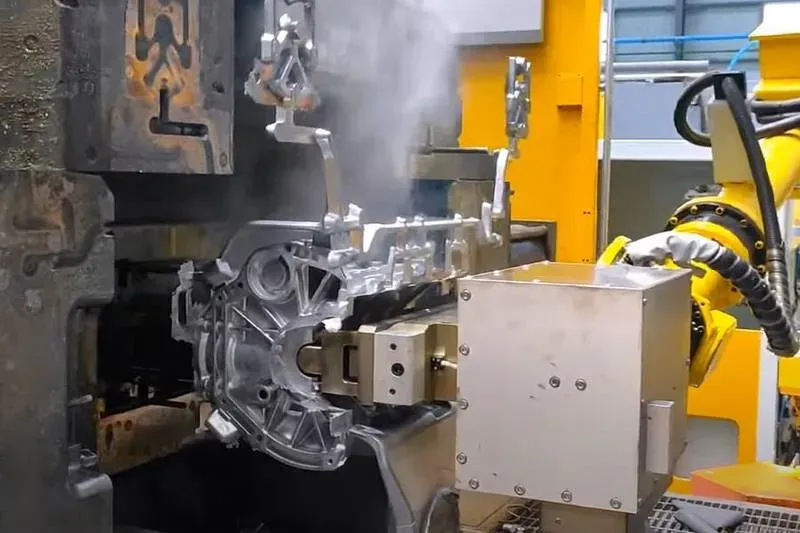
Many die casting defects are often discovered during production. However, experienced manufacturers understand that most defects are created much earlier – during the mold design stage. A die casting mold does much more than shape molten aluminum. It controls how molten metal enters the cavity, how air escapes, how heat is removed, how the metal solidifies, and how the finished part is ejected.
Engineering principle: A well-designed die casting mold does not only produce parts. It controls the entire casting process. Poor mold design can create defects that are extremely difficult to eliminate through machine adjustments alone.
4.1 Runner Design
The runner system guides molten aluminum from the shot sleeve into the cavity. A poorly designed runner can create turbulent flow, air entrapment, uneven filling, cold shuts, and excessive erosion. A well-designed runner should achieve smooth metal flow, balanced cavity filling, and stable filling patterns.
- Runner size: Controls metal flow volume
- Runner shape: Influences turbulence
- Flow direction: Determines filling pattern
- Transition design: Reduces flow separation
4.2 Gate Design
The gate is one of the most critical areas in a die casting mold. It determines where molten metal enters, filling velocity, flow direction, and solidification sequence. Incorrect gate design can cause porosity, cold shuts, air entrapment, and surface defects.
- Edge gate: Simple and widely used for general aluminum parts
- Fan gate: Spreads metal flow for thin-wall components
- Tab gate: Reduces turbulence for large surfaces
- Direct gate: Short flow path for simple geometries
4.3 Overflow and Venting Systems
Overflow systems are additional cavities designed to collect cold metal, oxide layers, trapped air, and contaminants. They improve casting quality by improving filling behavior and reducing defect concentration. During filling, the first metal entering the cavity often contains oxide film, cooler material, and air mixture – overflow areas provide a controlled location for these materials to move.
Venting is one of the most important mold design factors for preventing gas porosity, short shots, and surface defects. During filling, air inside the cavity must escape before molten metal reaches the final area. Poor venting causes trapped air, increased internal pressure, gas cavities, and incomplete filling.
4.4 Cooling System Design
Cooling design influences solidification speed, cycle time, porosity formation, and dimensional stability. A common mistake is designing cooling only for productivity. In reality, cooling design directly affects metallurgical quality. Poor cooling balance may create hot spots (shrinkage porosity), uneven cooling (warpage), excessive cooling (cold shuts), and thermal stress (cracks).
4.5 Vacuum Die Casting Mold Requirements
- Effective sealing: Maintain vacuum level
- Proper vent layout: Remove cavity air
- Optimized overflow: Capture remaining gas and impurities
- Stable process control: Maintain repeatability
5. How Process Parameters Influence Defect Formation
Even with a well-designed die casting mold, incorrect process control can still create quality problems. Defect prevention requires both good mold design and stable process control.
| Parameter | Main Function | Quality Impact |
|---|---|---|
| Injection speed | Controls molten metal filling | Affects turbulence and air entrapment |
| Injection pressure | Maintains cavity filling | Influences density and shrinkage |
| Metal temperature | Controls fluidity | Affects filling and defects |
| Die temperature | Controls solidification | Influences surface quality and cracks |
| Holding pressure | Compensates shrinkage | Reduces internal voids |
| Cooling time | Controls part strength | Affects dimensional stability |
Process window principle: A mature die casting manufacturer does not depend on operators adjusting machines by experience alone. They use process monitoring, parameter records, statistical analysis, and preventive maintenance. The objective is producing the same quality part repeatedly, not producing one successful sample.
6. Quality Inspection Methods for Die Casting Parts
Producing a qualified die casting part is not only about achieving the correct shape. A professional die casting supplier must control internal quality, dimensional accuracy, material consistency, surface appearance, and production stability. Because many die casting defects are hidden inside the part, visual inspection alone is not enough.
| Inspection Method | Purpose | Typical Application |
|---|---|---|
| Visual inspection | Surface defect checking | General aluminum parts |
| CMM measurement | Dimensional verification | Precision components |
| X-ray inspection | Internal porosity detection | Safety-critical parts |
| CT scanning | 3D internal analysis | High-value components |
| Leak testing | Pressure tightness verification | Housings, valves |
| Mechanical testing | Strength validation | Structural parts |
7. How to Evaluate a Die Casting Supplier
Choosing a die casting supplier should not be based only on unit price, production capacity, or delivery time. A reliable supplier should demonstrate capability in engineering support, mold development, process control, quality inspection, and production consistency.
7.1 Key Evaluation Factors
Engineering support – DFM feedback and design optimization
Mold capability – internal mold design and manufacturing
Material control – alloy quality and traceability
Defect prevention – root cause analysis capability
Inspection capability – CMM, X-ray, CT, leak testing
Production stability – process monitoring and SPC
Quality certifications – ISO 9001, IATF 16949, ISO 14001
Traceability – documentation and records
7.2 What Information Should Buyers Prepare Before Requesting a Quote?
- Product design information: 3D CAD files (STEP/IGES/SolidWorks), 2D drawings, critical dimensions, tolerance requirements
- Material requirements: Aluminum alloy specification (A380, ADC12, A360, AlSi alloys), mechanical requirements, surface treatment, operating environment
- Production requirements: Prototype quantity, annual volume, expected production schedule, packaging requirements
- Quality requirements: Inspection standards, critical dimensions, internal defect requirements, testing methods
8. Frequently Asked Questions
What are the most common die casting defects?
The most common defects include porosity, shrinkage cavities, cold shuts, misruns, flash, and cracks. Most defects are caused by interactions between mold design, material quality, and process parameters.
Can die casting defects be completely eliminated?
No manufacturing process can guarantee zero defects. However, experienced manufacturers can significantly reduce defects through proper mold design, process optimization, quality inspection, and preventive control.
Why does my die casting supplier have high defect rates?
Common reasons include poor mold design, unstable process control, insufficient inspection, and lack of engineering experience. The solution is usually improving the complete manufacturing system rather than changing one machine setting.
Is vacuum die casting better than traditional die casting?
Vacuum die casting provides better internal quality because it reduces trapped air. It is especially beneficial for structural parts, pressure-tight components, and heat-treated aluminum parts. However, it requires higher tooling complexity, better process control, and higher investment.
How can buyers reduce die casting production risks?
The best approach is to involve the supplier during the design stage, optimize mold design before production, define inspection requirements early, and validate prototypes before mass production.
9. Conclusion
Common die casting defects are not caused by a single factor. They result from the interaction between mold design, material quality, process parameters, and production control. The most effective defect prevention strategy is controlling the entire manufacturing system.
A reliable die casting supplier should provide engineering support, optimized mold design, stable production processes, and complete quality inspection. For companies developing aluminum die casting components, selecting the right manufacturing partner at the early design stage can significantly reduce development risks, production defects, and long-term manufacturing costs.
The goal of die casting is not only producing a part. The goal is creating a repeatable and reliable manufacturing process.
Need Help Reducing Die Casting Defects?
Every die casting project has unique challenges for quality, production volume, and manufacturing cost. Choosing the right mold design and process strategy early in the development process helps reduce defects, improve product quality, and shorten time to market.Request a Free Defect Prevention Analysis →
Turnaround within 48 hours. No obligation.
Disclaimer: This guide provides general technical information based on industry standards and engineering best practices. Actual results depend on specific alloys, equipment, and production conditions. Always validate with trials and consult qualified engineers for project-specific decisions.
References: NADCA Product Specification Standards, ASTM E94, ISO 9001, IATF 16949