
📌 Engineering Summary – Key Takeaways
- No universal volume threshold exists – the best process depends on CNC unit cost, mold investment, injection unit cost, part geometry, and product lifecycle.
- CNC machining offers lower upfront commitment and faster design changes – ideal for prototypes, low-volume parts, metal components, and uncertain demand.
- Injection molding requires higher tooling investment but delivers significantly lower unit cost at scale – ideal for stable plastic parts with predictable demand.
- Break-even analysis is a tool, not an automatic selector – always consider design stability, material, geometry, and lifecycle risk.
- Part geometry matters – ribs, bosses, snap-fits, and thin walls favor injection molding; deep pockets, precision holes, and flat surfaces often favor CNC.
- Total Cost of Ownership (TCO) includes tooling, unit cost, secondary operations, inspection, scrap, and design changes – unit price alone is misleading.
- Bridge tooling can be a practical intermediate step between CNC prototyping and production injection molding.
Bottom line: The right manufacturing process is not determined by production volume alone. It is determined by the complete project economics – including geometry, material, design stability, and product lifecycle.
1. Why Choosing Between CNC and Injection Molding Is More Complicated Than Comparing Unit Prices
When a new product moves from concept to production, one of the most common manufacturing decisions is whether to use CNC machining or injection molding.
At first, the decision may appear simple: CNC machining offers relatively low tooling investment and fast design changes. Injection molding requires a mold investment but can produce plastic parts at a much lower incremental cost when production volume increases.
The problem is that production volume alone does not determine the best process. A project with 500 parts may be better suited to injection molding if the CNC machining time is long and the geometry is highly repeatable. Another project with 5,000 parts may still make sense for CNC machining if the parts are made from metal, have complex machining requirements, or are expected to undergo frequent design changes.
Core principle: There is no universal production-volume threshold that automatically determines whether CNC machining or injection molding is better. The decision should be based on the complete project economics and lifecycle.
1.1 Quick Decision Framework
Is the design still changing? │ Yes → CNC Machining │ No → Is the part made from plastic? │ ┌────┴────┐ No Yes ↓ ↓ CNC Is production volume stable? │ ┌─────┴─────┐ No Yes ↓ ↓ CNC / Bridge Compare tooling + unit cost Tooling │ ↓ Injection Molding
*This decision tree provides a preliminary direction. A final process decision should be based on part geometry, material, tolerance, tooling cost, production volume, and product lifecycle.
2. What Are the Fundamental Differences Between CNC and Injection Molding?
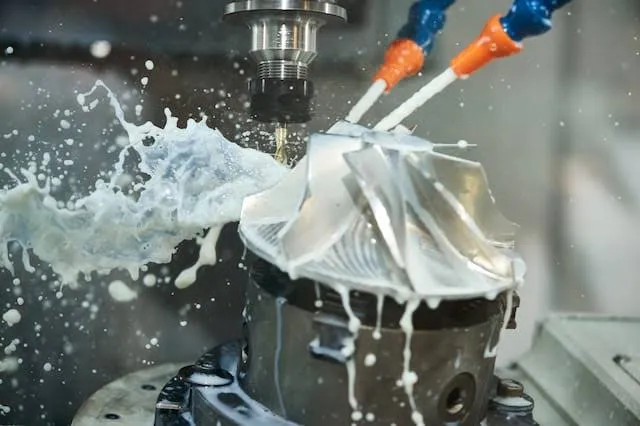
CNC machining is a subtractive process. Material is removed from a solid workpiece using cutting tools until the required geometry is produced.
Injection molding is a forming process. Molten plastic is injected into a mold cavity, where it cools and solidifies into the required shape.
| Factor | CNC Machining | Injection Molding |
|---|---|---|
| Manufacturing principle | Material removal | Material forming |
| Primary materials | Metals, plastics, and other machinable materials | Mainly thermoplastics, plus selected thermosets/elastomers |
| Tooling investment | Relatively low | Relatively high |
| Unit cost at high volume | Usually remains significant | Can become relatively low |
| Design changes | Relatively easy | Can require mold modification |
| Prototype suitability | Excellent | Less suitable before design freeze |
| Production repeatability | High with process control | High with stable mold and process |
| Scalability | Limited by machining hours | Highly scalable after tooling |
| Best fit | Prototypes, low-volume parts, metal components | Stable plastic parts and larger production runs |
Key insight: CNC concentrates more of the manufacturing cost in each individual part, while injection molding shifts a significant portion of the project cost into tooling and engineering before production begins.
3. How Does Production Volume Change the Economics of CNC and Injection Molding?
Production volume is one of the most important variables, but it cannot alone determine the manufacturing process.
The major economic difference between the two processes is when costs are incurred:
- CNC machining: A larger percentage of the manufacturing cost is incurred as each individual part is produced.
- Injection molding: A significant portion of the project cost is committed before production begins through mold design and tooling.
CNC Machining Low Initial Tooling ↓ Higher Variable Cost ↓ Cost Grows With Quantity — Injection Molding Higher Initial Tooling ↓ Lower Variable Cost ↓ Tooling Cost Amortized Over Quantity
3.1 Basic Cost Models
CNC Total Cost = CNC Fixed Cost + CNC Unit Cost × Quantity
Injection Total Cost = Mold Cost + Injection Fixed Cost + Injection Unit Cost × Quantity
For simplified comparison:
- CNC Total Cost = C × Q (where C = CNC cost per part)
- Injection Total Cost = M + I × Q (where M = mold cost, I = injection cost per part)
4. How to Calculate the Break-Even Point Between CNC and Injection Molding
Break-Even Formula:
Q = M ÷ (C − I)
Where Q = break-even quantity, M = mold investment, C = CNC cost per part, I = injection cost per part.
4.1 Real Example
| Cost Factor | CNC Machining | Injection Molding |
|---|---|---|
| Initial tooling/setup | $500 | $10,000 mold |
| Unit production cost | $20 | $3 |
Break-Even Quantity = $10,000 ÷ ($20 − $3) ≈ 588 parts
| Quantity | CNC Total Cost | Injection Total Cost | Lower-Cost Option |
|---|---|---|---|
| 100 | $2,500 | $10,300 | CNC |
| 500 | $10,500 | $11,500 | CNC |
| 1,000 | $20,500 | $13,000 | Injection |
| 5,000 | $100,500 | $25,000 | Injection |
4.2 Why There Is No Universal Rule
The break-even point changes whenever the mold cost or unit production cost changes. Different projects produce completely different results:
| Project | CNC Cost | Mold Cost | Injection Cost | Break-Even |
|---|---|---|---|---|
| A | $10 | $20,000 | $2 | 2,500 |
| B | $50 | $8,000 | $3 | ~170 |
| C | $4 | $30,000 | $2 | 15,000 |
Key insight: The more expensive CNC machining becomes per part, the sooner injection molding can become economically attractive. Part complexity directly affects CNC unit cost and therefore changes the break-even point.
Every project has unique requirements for production volume, material, geometry, and cost. Choosing the right process early helps reduce risk, improve product quality, and shorten time to market. Our engineering team can evaluate your project and recommend the optimal manufacturing strategy.Request a Free Manufacturing Feasibility Analysis →
5. How Does Production Volume Affect the Manufacturing Strategy?
5.1 Production Volume Matrix
| Production Situation | CNC Machining | Injection Molding | Potential Strategy |
|---|---|---|---|
| Prototype | Strong | Usually inefficient | CNC |
| Very low volume | Strong | Tooling may dominate cost | CNC |
| Low volume + stable plastic design | Possible | Evaluate tooling | CNC / Bridge |
| Medium volume | Depends on geometry | Increasingly attractive | Compare TCO |
| High volume | Machine capacity becomes important | Usually strong | Injection |
| Uncertain demand | Low tooling commitment | Higher risk | CNC / Bridge |
| Long product lifecycle | Variable cost accumulates | Tooling can be amortized | Injection |
5.2 Lifecycle Strategy
A mature product does not necessarily start with production injection molding. A more practical path is often:
Concept ↓ Prototype ↓ CNC Machining ↓ Functional Validation ↓ Pilot Production ↓ Bridge Tooling ↓ Production Mold ↓ Mass Production
6. How Does Part Geometry Affect the Decision?
CNC and injection molding handle “complex geometry” in completely different ways.
| Feature | CNC Machining | Injection Molding |
|---|---|---|
| External profile | Generally easy | Generally easy |
| Holes | Easy | Requires core pins |
| Deep pockets | Possible but costly | Mold design dependent |
| Thin ribs | Difficult to machine | Often suitable |
| Bosses | Easy but time-consuming | Highly suitable |
| Undercuts | Tool access limitation | Slides/lifters may solve |
| Complex curved surfaces | Possible | Often efficient after tooling |
| Internal cavities | Tool access dependent | Core/cavity design dependent |
Key insight: Manufacturing complexity is process-specific. A geometry that is expensive to machine may be inexpensive to reproduce through injection molding once the mold has been developed.
7. How Does Lead Time Affect the Choice?
Lead time should be evaluated in two dimensions:
- Time to First Functional Part – how quickly can you get the first usable part?
- Time to Production Readiness – how quickly can you complete the required quantity?
| Project Requirement | More Likely Advantage |
|---|---|
| Fast first prototype | CNC |
| Frequent design changes | CNC |
| Small quantity | CNC |
| Stable high-volume plastic production | Injection molding |
| Fast repeat production after tooling | Injection molding |
| Uncertain demand | CNC / bridge tooling |
| Long-term production program | Injection molding |
8. What Costs Should Be Included When Comparing CNC and Injection Molding?
8.1 CNC Cost Items
- Material – raw material, stock allowance, waste
- Programming – CAM programming and setup
- Machine setup – fixturing and workholding
- Machining – milling, turning, drilling, etc.
- Tooling – cutting tools and special tooling
- Inspection – dimensional inspection and CMM
- Finishing – anodizing, plating, polishing, coating
- Assembly – additional component assembly
- Packaging – protection and customized packaging
- Engineering – DFM and design review
8.2 Injection Molding Cost Items
- Mold design – mold engineering and DFM
- Mold manufacturing – CNC, EDM, grinding, polishing
- Mold components – inserts, sliders, ejector system
- Mold trials – T0, T1, T2 and additional trials
- Mold modification – design changes after trials
- Injection molding – machine and cycle cost
- Resin – plastic material
- Scrap – startup and production scrap
- Secondary operations – assembly, machining, finishing
- Inspection – dimensional and functional inspection
- Mold maintenance – cleaning, repair, replacement
Key insight: The cheapest unit price is not always the lowest total manufacturing cost. Always compare finished-part cost – not only the primary process cost.
9. How Should Buyers Evaluate a Manufacturing Supplier?
9.1 RFQ Information Checklist
3D CAD model
2D drawing with critical dimensions and tolerances
Material specification
Expected quantity and annual demand
Product lifecycle estimate
Surface finish requirements
Critical tolerances and inspection requirements
Assembly requirements
Target delivery date
9.2 Questions to Ask Suppliers
- Does the quote include tooling?
- Does it include mold trials? How many trial rounds?
- Are mold modifications included?
- Is material included?
- Is inspection included?
- Is surface finishing included?
- Is assembly included?
- What scrap assumption is used?
- What happens if the design changes?
- Is packaging included?
10. Frequently Asked Questions
Is there a universal rule for when to choose CNC vs injection molding?
No. The decision depends on CNC unit cost, mold investment, injection unit cost, part geometry, design stability, and product lifecycle – not on a fixed quantity threshold.
What is the break-even point between CNC and injection molding?
The break-even quantity is calculated as Q = M ÷ (C − I) – where M is mold cost, C is CNC cost per part, and I is injection cost per part. This varies greatly between projects.
When should I choose CNC machining?
Choose CNC when the design is still changing, production volume is low, the part is metal, tooling investment cannot be justified, or fast delivery is critical.
When should I choose injection molding?
Choose injection molding when the design is stable, production volume is high, the part is plastic, long-term production is planned, and the mold investment can be amortized over the product lifecycle.
What is bridge tooling?
Bridge tooling is a manufacturing approach between CNC prototyping and production injection molding. It allows companies to produce medium volumes while final production tooling is being developed.
Can a CNC prototype be directly used for injection molding?
Not automatically. The geometry may require modifications for draft angles, parting lines, wall thickness uniformity, and gate location. A DFM review is recommended before tooling.
Which process is better for complex plastic parts?
Injection molding is generally more efficient for complex plastic parts with ribs, bosses, snap-fits, and thin shells – once the mold has been developed. However, for low volumes, CNC may still be more economical.
11. Conclusion
CNC machining and injection molding solve different manufacturing problems. The biggest mistake companies make is choosing a process based on only one factor – typically unit price or production volume alone.
The correct decision should balance:
- Production volume – expected and annual demand
- Design maturity – is the design stable?
- Part geometry – what features does the part have?
- Material – metal or plastic?
- Tooling investment – can it be amortized?
- Product lifecycle – how long will the product be produced?
- Lead time – when are parts needed?
Final advice: Use break-even analysis as a decision-support tool – not as an automatic process selector. Always consider the complete project economics, and involve your manufacturing partner early in the design stage.
Need Help Choosing the Right Manufacturing Process?
Every project has unique requirements for production volume, material, geometry, and cost. Choosing the right process early helps reduce risk, improve product quality, and shorten time to market. Our engineering team can evaluate your project and recommend the optimal manufacturing strategy.Request a Free Manufacturing Feasibility Analysis →
Turnaround within 48 hours. No obligation.
Disclaimer: This guide provides general technical information based on industry standards and engineering best practices. Actual results depend on specific materials, equipment, and production conditions. Always validate with trials and consult qualified engineers for project-specific decisions.