
Project Background and Key Challenges
This precision-manufactured, lightweight aerospace bracket was produced as a custom order for an overseas aerospace customer. Designed specifically for lightweight load-bearing structures in aircraft, dimensional accuracy, material stability, and delivery speed are critical to the customer’s project progress. How can manufacturers quickly respond to custom orders, overcome complex machining challenges, and deliver high-quality parts on time, while ensuring consistent performance and accuracy in small-batch prototype production?
The customer’s core requirements include precise assembly alignment, dimensional stability of the structure, long-term mechanical fatigue resistance, and rapid delivery to avoid delays in the R&D project schedule. The aerospace bracket’s complex, open-work, topologically irregular structure and strict material requirements (TC4 titanium alloy) pose significant challenges to machining efficiency and precision control.
Key Manufacturing Challenges
Traditional forging combined with CNC machining faces significant technical bottlenecks and cannot meet the standards for custom aerospace manufacturing:
1. Complex structures cannot be formed as a single piece: Hollow topologies and multi-curved, irregular structures cause tool interference; traditional processes require machining in separate parts followed by welding and assembly, which can easily lead to weld defects and assembly errors;
2. Titanium alloy machining is extremely challenging: TC4 titanium alloy has poor thermal conductivity and high toughness, making it prone to tool vibration and thin-wall deformation during machining, resulting in a high scrap rate for complex openwork structures;
3. Significant waste of raw materials: Traditional solid forgings require over 70% material removal during machining, leading to high consumption of expensive titanium alloy materials and persistently high manufacturing costs;
4. Long lead times: The entire process—including mold making, machining, welding, and non-destructive testing—takes more than 30 days, making it impossible to keep pace with rapid new product iterations;
5. Limited weight reduction: Traditional processes only support simple hole-drilling for weight reduction, achieving a weight reduction rate of just 10%–15%, which fails to meet the weight reduction requirements for aerospace upgrades.
XINXIU Manufacturing Method
Faced with overseas customers’ requests for custom structures, titanium alloy materials, and urgent delivery deadlines, XINXIU’s prototyping department demonstrated exceptional responsiveness: Upon receiving the customer’s drawings, the team completed a process evaluation and began production within 24 hours, completely resolving the customer’s urgent delivery challenges. The entire machining process is strictly controlled and standardized, prioritizing structural accuracy, mechanical properties, and consistency across batches.
First, topological optimization design was conducted using finite element simulation to eliminate redundant material and optimize the load-bearing structure. The team then completed model repair, support structure layout, and slice parameter tuning, laying the foundation for high-precision manufacturing.
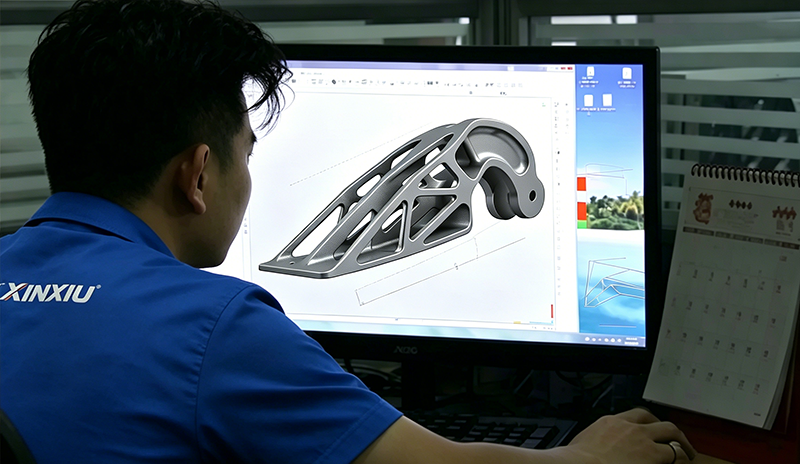
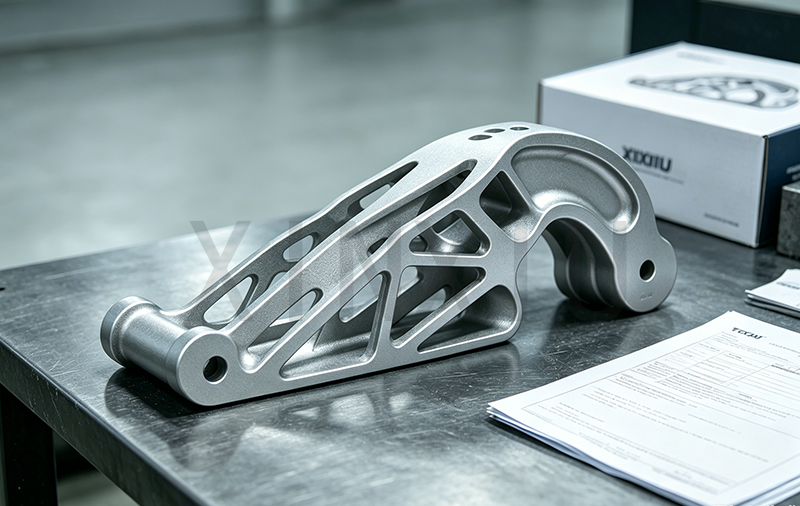
Next, aerospace-grade TC4 titanium alloy powder is used to create a complete, hollow scaffold blank in a single print via SLM metal 3D printing technology, with layer-by-layer fusion in an argon-inert atmosphere. This process eliminates the need for disassembly and welding, perfectly reproducing the complex topological and irregular structures.
After printing, standardized post-processing was performed: the part was separated from the build plate via wire cutting, and all process supports were removed; vacuum heat treatment was applied to eliminate internal stresses, stabilize the properties of the titanium alloy, and prevent deformation during subsequent machining; key areas such as mounting holes and alignment references underwent high-precision CNC finishing to strictly control assembly tolerances; finally, sandblasting was used to optimize surface texture and eliminate layer lines and sintering residues.
Professional, comprehensive inspection and evaluation are conducted throughout the entire process to identify various defects such as porosity, microcracks, and dimensional deviations. Critical dimensions and mechanical properties meet specifications 100%, and the final high-quality finished products are packaged and delivered.
Core Customer Value
This custom aviation bracket project leverages an integrated SLM metal 3D printing process to perfectly address the shortcomings of traditional manufacturing, providing customers with a comprehensive solution featuring high precision, high strength, lightweight design, and fast delivery, thereby effectively ensuring the progress of their projects.
✅ 24-hour rapid response and production launch: Rapid drawing evaluation and immediate production scheduling significantly shorten the new product R&D preparation cycle
✅ Ultra-lightweight manufacturing: Topology-optimized structural design reduces weight by 42% compared to traditional solid brackets, effectively lowering the aircraft’s load and energy consumption
✅ Aerospace-Grade Mechanical Properties: TC4 titanium alloy combined with precision heat treatment ensures strong structural integrity and excellent fatigue resistance
✅ Micrometer-Level Precision Tolerances: CNC machining of critical assembly locations keeps dimensional tolerances within ±0.02 mm, ensuring precise assembly fit
✅ High Material Utilization for Cost Reduction: Titanium alloy powder is recyclable and reusable, with material utilization exceeding 95%, significantly reducing raw material costs
✅ 100% Qualified Delivery: Standardized quality inspection throughout the entire process ensures zero-defect finished products that fully comply with aerospace installation standards
✅ Rapid Iteration and Delivery: No tooling required; prototype delivery cycles are compressed to 3–7 days, preventing customer project delays
The Next Step in Our Collaboration
Lightweight structural components for the aviation and drone industries commonly face two major challenges: complex, irregularly shaped structures that are difficult to machine, and the high precision requirements for forming special titanium alloys. At the same time, rapid product iteration and tight delivery schedules present widespread manufacturing challenges across the industry.
Suitable for a wide range of industry applications:
Aerospace equipment—lightweight topological load-bearing brackets, irregularly shaped connecting structures, and precision hollow aircraft components
Drone systems—high-strength lightweight frames, biomimetic-optimized support structures, and transmission connection parts
High-end smart equipment—precision titanium alloy structural components, irregularly shaped load-bearing assemblies, and custom lightweight parts
If your custom project faces challenges in complex structural forming, specialty material processing, extreme lightweighting, or urgent delivery, please feel free to contact XINXIU at any time. Our rapid-response team and proven additive manufacturing technology can efficiently resolve various precision manufacturing challenges and help bring your project to fruition quickly.