
1. Introduction
Injection molding remains one of the most efficient and widely adopted manufacturing processes for mass-producing plastic components. As global regulations and consumer demand shift toward environmental responsibility, recycled polymers have moved from a niche option to a mainstream material choice in injection molding. Manufacturers today face a critical question: can recycled plastics deliver consistent performance while meeting strict sustainability goals?
At Xinxiu Precision Technology, we specialize in custom injection molding, die casting, rapid prototyping, CNC precision parts, sheet metal, and silicone components. We work with both virgin and recycled resins daily, helping brands balance quality, cost, and carbon footprint. This article breaks down the technical performance metrics of recycled polymers, compares them to virgin plastics, and provides actionable guidelines for implementing recycled materials in your injection molding projects.
2. What Are Recycled Polymers? (PCR vs. PIR)
Recycled polymers fall into two primary categories used in injection molding:
- PCR (Post-Consumer Recycled): Plastics collected from household and commercial waste—bottles, packaging, electronic housings, and consumer goods. PCR resins are more variable in quality but offer the highest sustainability impact.
- PIR (Post-Industrial Recycled): Factory scrap, sprues, runners, and offcuts from manufacturing. PIR is more consistent, easier to process, and often blended with virgin resin at 20–50% ratios.
Common recycled resins for injection molding include PP, HDPE, LDPE, ABS, and PC/ABS. Each polymer type behaves differently when recycled, affecting mechanical properties, melt flow, and surface finish.
3. Performance Metrics: Recycled vs. Virgin Polymers
When evaluating recycled polymers for injection molding, manufacturers must test key performance indicators (KPIs). Below is a practical comparison based on industry data and our experience at Xinxiu Precision Technology.
3.1 Mechanical Properties
- Tensile Strength: Virgin = baseline; 20–30% PCR blend = –3% to –8%; 100% PCR = –10% to –25%.
- Impact Strength: Typically drops 15–40% in 100% recycled material, especially with multiple recycling cycles.
- Flexural Modulus: Slight reduction (5–10%) for most PCR blends; HDPE may show improved stiffness.
Why it matters: Lower impact strength can lead to brittle parts, especially in thin-wall injection molding. At Xinxiu Precision Technology, we adjust gate design and cooling parameters to reduce stress concentrations when using recycled resins.
3.2 Melt Flow and Processability
Recycled polymers show wider melt flow index (MFI) variation (±15–30%) compared to virgin resins.
- Higher MFI (more flowable): easier to fill thin cavities, but higher shrinkage and warpage risk.
- Lower MFI: requires higher injection pressure, increases mold wear.
Moisture sensitivity is also higher in recycled plastics, requiring aggressive drying (80–120°C for 2–4 hours) to prevent splay and bubble defects.
3.3 Dimensional Stability and Warpage
- PP: Warpage increases with higher PCR content due to inconsistent shrinkage.
- HDPE: Warpage often decreases with recycled content due to lower viscosity and more uniform packing.
At Xinxiu Precision Technology, we use rapid mold flow simulation to predict warpage and optimize runner systems before mass production—critical when working with variable recycled resins.
3.4 Surface Quality and Aesthetics
Recycled polymers often exhibit:
- Color variation: yellowing or gray tones, especially in 100% PCR.
- Specks and streaks: from contamination or inconsistent regrinding.
- Gloss reduction: compared to virgin resin finishes.
For visible parts, we recommend 20–40% PCR blends with virgin resin, or using PIR for better consistency. We also offer in-mold coloring and post-mold finishing to improve surface appearance.
3.5 Mold Wear and Maintenance
Recycled plastics contain more contaminants, fillers, and degraded polymer chains, accelerating mold wear (especially at gates and thin walls).
- Mitigation: Use premium mold steels (ASSAB, DAIDO), add filtration screens, and implement stricter batch testing.
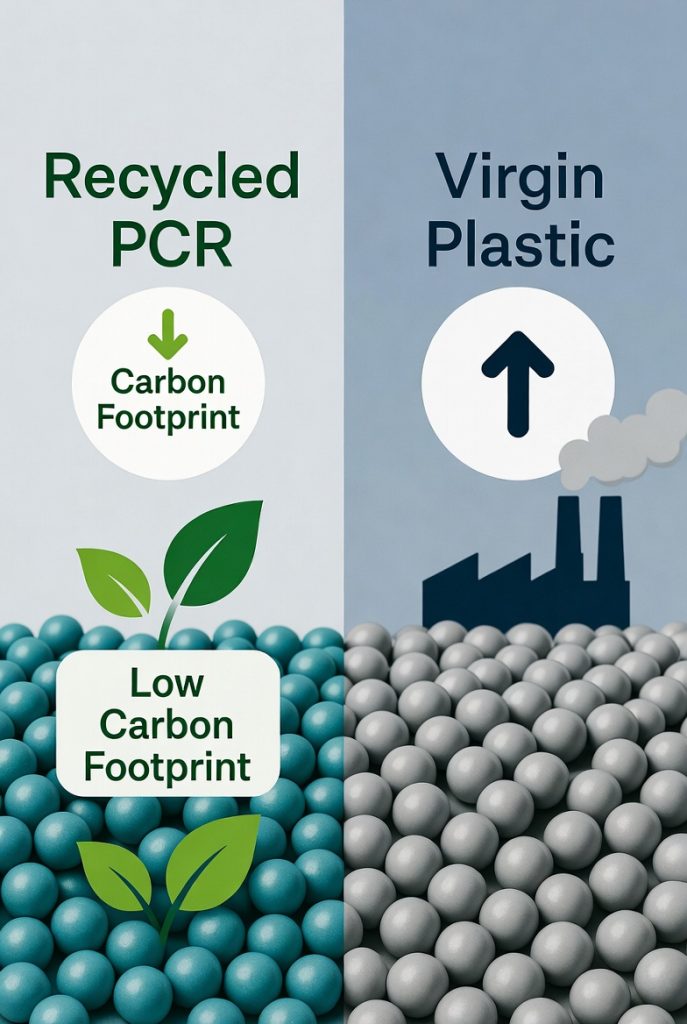
4. Sustainability Metrics: The Eco Benefits of Recycled Polymers
If performance is the technical side, sustainability is the business and environmental side. The numbers are compelling:
- Carbon footprint reduction: 60–80% lower than virgin plastic production.
- Energy savings: 70–80% less energy required for recycling vs. virgin polymerization.
- Resource conservation: 1 ton recycled plastic saves 2–3 tons crude oil and reduces landfill by 3–4 m³.
- Waste reduction: diverts millions of tons of plastic from landfills and oceans annually.
4.1 Regulatory and Brand Requirements
Global regulations push recycled content mandates:
- EU Packaging Directive: minimum recycled content targets for plastic packaging.
- GRS (Global Recycled Standard): certification required by major brands for recycled content claims.
- Consumer demand: 60%+ of buyers prefer products with recycled or eco-labels.
4.2 Cost Savings: Long-Term Economic Sustainability
- Material cost: recycled pellets cost 15–25% less than virgin resins.
- Total cost: even with extra drying, filtration, and testing, net savings for 30% PCR conversion often reach $40,000/year with a 3.5-month payback period.
5. Balancing Performance and Sustainability: Best Practices
Based on thousands of recycled resin projects at Xinxiu Precision Technology, here’s how to balance quality and eco-goals:
5.1 Choose the Right Resin Blend Ratio
- Non-visible, structural parts: 50–100% PIR or PCR (PP/HDPE ideal).
- Visible, consumer-facing parts: 20–40% PCR + virgin blend (ABS/PC-ABS).
- High-precision, thin-wall parts: 10–20% PIR only.
5.2 Optimize Injection Molding Parameters
- Dry thoroughly: 80–120°C, 2–4 hours, reduce moisture to <0.1%.
- Increase back pressure: improves melt homogeneity and reduces speckles.
- Extend cooling time: minimizes warpage from uneven shrinkage.
- Use larger gates: reduces shear stress and mold wear.
5.3 Implement Quality Control and Testing
- Batch testing: MFI, tensile, impact, color, and contamination checks.
- Certifications: GRS, ISO 14001 for sustainability claims.
- Rapid prototyping: test recycled resin performance before mass production.
5.4 Partner with an Experienced Manufacturer
Working with a supplier experienced in both precision injection molding and recycled polymers eliminates trial-and-error costs. At Xinxiu Precision Technology, we offer:
- Material consulting: resin selection and blend ratio design.
- Rapid mold and prototyping: validate recycled resin performance quickly.
- Full production: from small-batch to high-volume injection molding.
- Sustainability reporting: track carbon footprint and recycled content metrics.
6. Conclusion
Recycled polymers in injection molding are no longer a tradeoff between performance vs. sustainability—they are a balance that can be achieved with the right material selection, process optimization, and quality control. While 100% PCR may not suit every application, strategic blending (20–50%) delivers meaningful eco-benefits without sacrificing part quality.
At Xinxiu Precision Technology, we help brands turn sustainability goals into high-quality, cost-effective injection-molded parts. Whether you need custom injection molding, rapid prototypes, CNC precision components, or silicone parts, we integrate recycled materials seamlessly into your production plan.
Ready to explore recycled polymer options for your next project? Contact Xinxiu Precision Technology today for material consulting, DFM analysis, and sustainable manufacturing solutions.